Species → Great White Shark
Great White Shark
Carcharodon carcharias
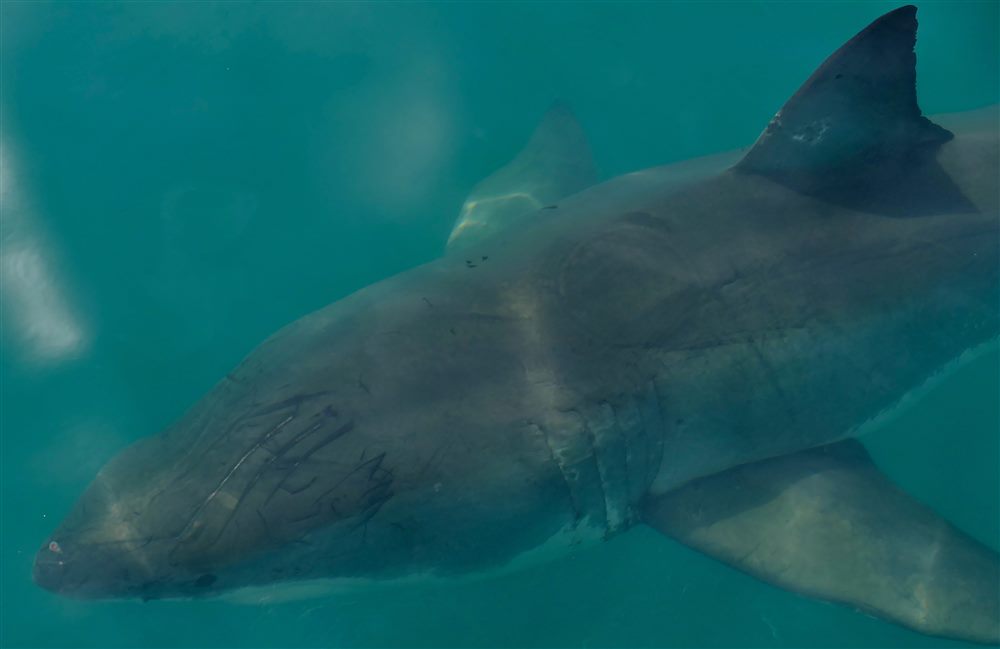
The great white shark is the apex predator of temperate coastal waters. Its IUCN status is Vulnerable, with regional populations in decline (South Africa, Mediterranean) and others recovering (Cape Cod). False Bay offered a natural experiment: its gradual disappearance between 2015 and 2019 coincided with a rise in Cape fur seals and copper sharks — a trophic cascade observed in real time, at the root of this entry.
What if it disappeared?
Impact HighIn the year following its disappearance from an area, Cape fur seals and sevengill sharks would likely venture more freely into zones they once avoided — but the measured drop in small fish and small sharks that follows, observed in False Bay, took several years to show up, not just one.
ExtrapolatedDetail
Extrapolation à partir de Hammerschlag et al. (2025), qui documentent la cascade complète sur la fenêtre 2015-2019, pas spécifiquement l'année suivant la disparition.
The False Bay study observes a gradual disappearance of the great white shark between 2015 and 2019, with measured effects — a rise in fur seals and sevengill sharks, a drop in small fish and small sharks — that built up over several years. A behavioral shift among these predators, such as expanding their hunting range, is plausible within the first year, but the measured decline further down the food chain takes longer to register.
What's missing to confirm it: No published measurement distinguishes what happens in the first twelve months from what accumulates over the study's full four years.
In False Bay, the gradual disappearance of the great white shark between 2015 and 2019 coincided with a rise in Cape fur seals and sevengill sharks, a measured 44% drop in the small fish seals feed on, and a 72% and 42% decline in two small shark species preyed on by sevengill sharks — the most complete direct measurement of a cascade triggered by the loss of a great white shark.
DocumentedDetail
Hammerschlag, N., Herskowitz, Y., Fallows, C. & Couto, T.B.A. (2025). Evidence of cascading ecosystem effects following the loss of white sharks from False Bay, South Africa. Frontiers in Marine Science.
The study combines more than twenty years of boat-based surveys, citizen-science observations of Cape fur seals, and baited underwater video surveys (BRUVS) of fish and small sharks — one of the rare cases where a large shark's decline is documented alongside its cascading effects on at least two lower trophic levels, rather than inferred after the fact.
Over a century, the imbalance between seals, sevengill sharks, and their prey observed in False Bay would likely have had time to settle into a new, lasting state, where small fish and small shark populations stay structurally lower than before the great white shark's disappearance, rather than recovering on their own.
HypothesisOver a thousand years without great white sharks across their entire range, the loss of the control they exert over fur seals and sevengill sharks would likely spread well beyond False Bay, down to the fish and invertebrates these expanding populations themselves depend on — a food-web rearrangement that the shark's return, even after such a long absence, might not be enough to undo.
HypothesisDocumentation
-
Hammerschlag et al. (2025) — Evidence of cascading ecosystem effects following the loss of white sharks from False Bay, South Africa, Frontiers in Marine Science
Accessed August 10, 2026
-
IUCN Red List — Carcharodon carcharias, statut de conservation
Accessed August 10, 2026
Last verified: August 16, 2026