Species → Tiger Shark
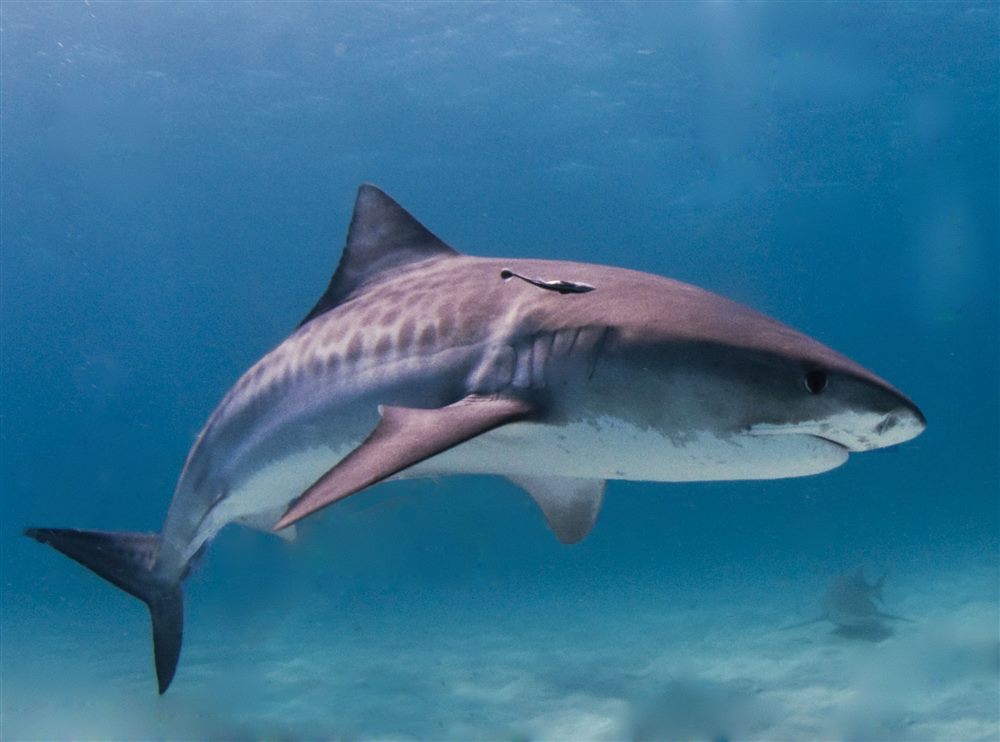
Tiger Shark
Galeocerdo cuvier
What if it disappeared?
Impact HighWithout tiger sharks creating a predation risk, Shark Bay's dugongs would likely graze longer in the rich interior of seagrass beds, rather than sticking to the less nutritious but safer edges they favor today — a food-versus-safety trade-off that varies directly with the risk of encountering a tiger shark.
DocumentedDetail
Wirsing, A.J., Heithaus, M.R. & Dill, L.M. (2007). Living on the edge: dugongs prefer to forage in microhabitats that allow escape from rather than avoidance of predators. Animal Behaviour, 74, 93–101.
Monitoring seven study areas over several years shows dugongs constantly weighing seagrass quality against their ability to flee quickly from an attack, because long grazing or resting bouts leave them vulnerable to a surprise strike. The same "landscape of fear" mechanism has been documented in the green turtle, which shares this seagrass bed (see the green turtle entry).
Ten years after the 2011 marine heatwave, which destroyed more than 90% of the seagrass in several areas of Shark Bay, exclusion cages simulating the absence of tiger sharks showed that the main seagrass meadow failed to recover under intensified grazing — the shark's presence, through the risk it poses to grazers, proved necessary for the seagrass to regrow.
DocumentedDetail
Nowicki, R.J. (2021). Loss of predation risk from apex predators can exacerbate marine tropicalization caused by extreme climatic events. Journal of Animal Ecology.
Twenty experimental plots (2.5 × 3 m, steel-frame cages) were distributed between "safe" and "risky" habitats based on tiger shark predation risk already mapped by previous studies. The 2011 heatwave had destroyed more than 90% of the seagrass in several areas — a real-world test of what happens when predation risk disappears just as the ecosystem is most vulnerable.
Over a century, a seagrass meadow that never again benefited from the brake tiger sharks put on grazing would have little chance of recovering after each new heatwave: with no predation risk to limit dugongs and turtles, Shark Bay's seagrass could stay durably sparse after every climate disturbance, rather than regaining its original extent.
HypothesisOver a thousand years, the bay could stop functioning as the seagrass habitat it is today: without the predation risk that limits grazing by dugongs and green turtles, a more regularly bare seabed could take hold for good, supporting a different marine community than the one the bay hosts now.
HypothesisDocumentation
-
Wirsing, Heithaus & Dill (2007) — Living on the edge: dugongs prefer to forage in microhabitats that allow escape, Animal Behaviour
Accessed August 7, 2026
-
Nowicki (2021) — Loss of predation risk from apex predators can exacerbate marine tropicalization, Journal of Animal Ecology
Accessed August 7, 2026
-
IUCN Red List — Galeocerdo cuvier, statut et tendance
Accessed August 7, 2026
Last verified: August 16, 2026