Species → Blue Wildebeest
Blue Wildebeest
Connochaetes taurinus
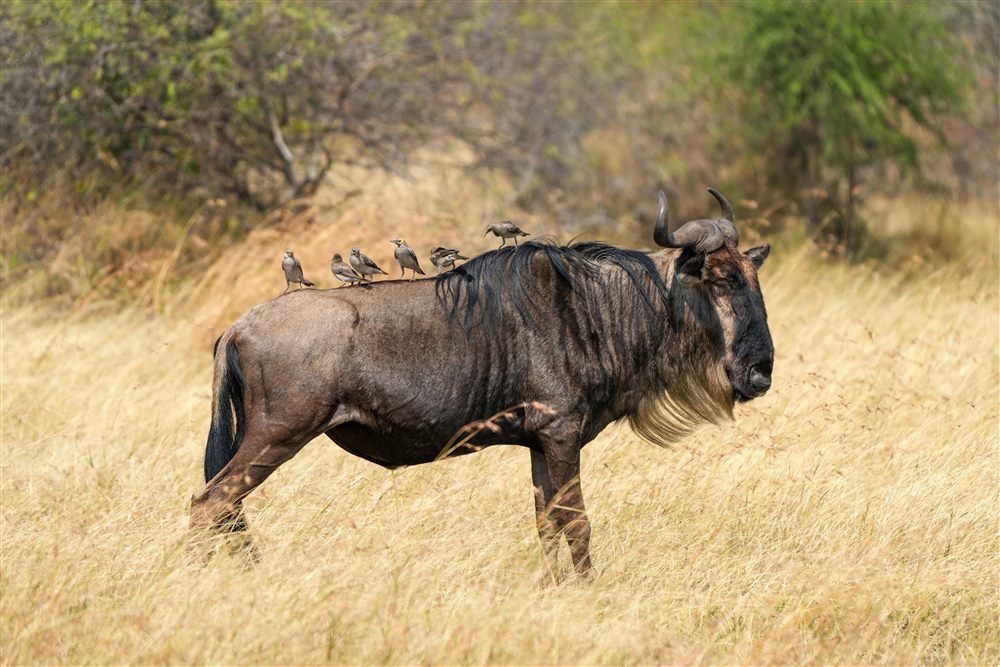
What if it disappeared?
Impact MajorIn the model reconstructing decades of Serengeti dynamics, wildebeest abundance in a given year, together with rainfall variation, ranks among the two best predictors of fire occurrence that same year: without them grazing the grass, a single dry season would be enough to turn the ungrazed surplus into more extensive fires.
DocumentedDetail
Holdo, R.M., Sinclair, A.R.E. et al. (2009). A disease-mediated trophic cascade in the Serengeti and its implications for ecosystem carbon. PLoS Biology, 7(9), e1000210.
The model identifies wildebeest abundance and within-year rainfall variation as the best predictors of fire occurrence, at an annual scale — fire itself being the main driver of the observed changes in tree density. This is a relationship that plays out from the very first year without grazers, even before the wildebeest population has had time to change over the longer term.
Repeated over a decade, these more extensive fires would prevent young trees from establishing in the savanna — exactly what happened before the 1960s, when rinderpest kept wildebeest at a fraction of their current numbers. Tree recruitment only resumed after the disease was eradicated, when the wildebeest population grew from about 250,000 to over a million within about fifteen years.
DocumentedDetail
Holdo, R.M., Sinclair, A.R.E. et al. (2009). A disease-mediated trophic cascade in the Serengeti and its implications for ecosystem carbon. PLoS Biology, 7(9), e1000210.
The study reconstructs the dynamics over decades from aerial censuses, fire surveys, and tree-density measurements — fire being the main driver of the observed changes in tree density. The low-wildebeest phase, which lasted for decades before the 1960s, shows what a decade or more of fires unchecked by grazing produces.
Sustained over a century rather than the fifteen years actually observed, this repeated-fire regime would probably tip the Serengeti from the net carbon sink it is today — currently drawing down on the order of a million tonnes a year — back to the net source it was before wildebeest returned, since the authors' model directly links tree density to landscape carbon stocks.
ExtrapolatedDetail
Même étude, Holdo & Sinclair et al. 2009, PLoS Biology — les auteurs distinguent explicitement ce volet comme modélisé plutôt que mesuré.
The authors say so themselves: lacking repeated data on the size-class distribution of trees, they must assume carbon stocks are directly proportional to observed tree density alone. Extending their fire-tree-carbon relationship, measured over some fifteen years of wildebeest recovery, out to a century of total absence remains an extrapolation, not a direct measurement at that timescale.
What's missing to confirm it: Repeated monitoring of the size-class distribution (not just the density) of Serengeti trees, extended over several decades, would make it possible to verify whether the tip toward a net carbon source truly holds at century scale rather than being inferred from a proportionality assumption.
Over a thousand years of this fire regime, the Serengeti would likely lose its oldest, slowest-growing trees — the ones that need long fire-free stretches to reach full size. Once gone, those centuries-old trees wouldn't grow back within a human lifetime, even if wildebeest eventually returned — unlike the grass and fires, which would respond to their return within just a few years.
HypothesisDocumentation
-
Holdo, Sinclair et al. (2009) — A disease-mediated trophic cascade in the Serengeti and its implications for ecosystem carbon, PLoS Biology
Accessed August 7, 2026
-
PMC — texte intégral de l'étude Holdo et al. 2009
Accessed August 7, 2026
-
Wikipedia (synthèse sourcée IUCN) — Blue wildebeest, statut et population
Accessed August 7, 2026
Last verified: August 16, 2026