Species → African savanna elephant
African savanna elephant
Loxodonta africana
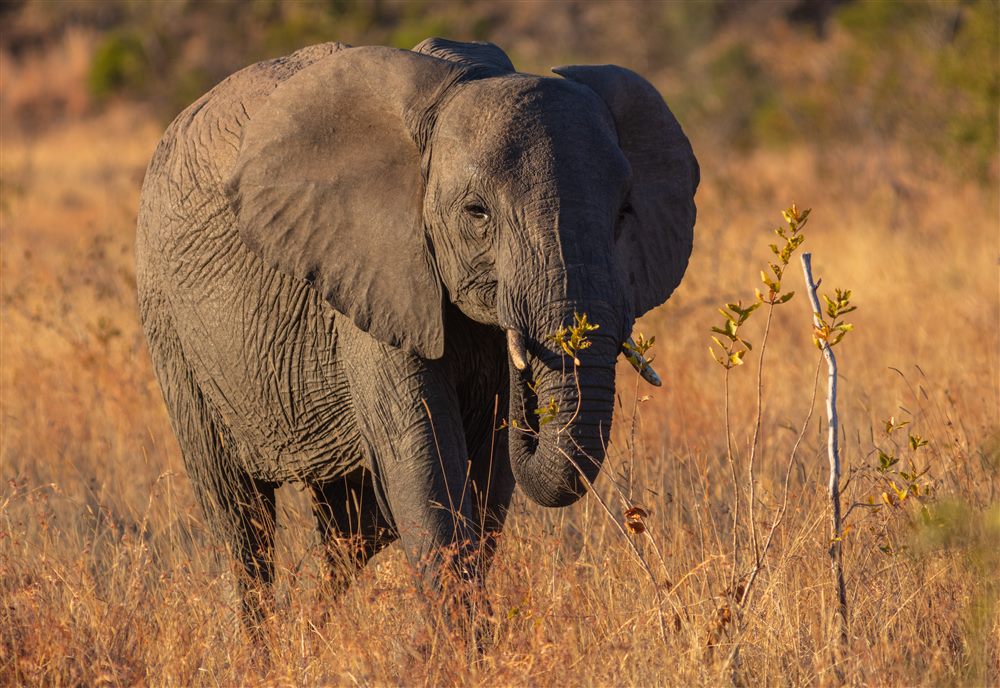
The African savanna elephant is an ecosystem engineer of the savanna: by preferentially felling and uprooting certain trees, it keeps habitats open. Its IUCN status is Endangered: more than 60% of the population lost since 1965. Its disappearance would let the savanna close over into woody cover — a landscape change that plays out over decades and would not simply reverse when it returns.
What if it disappeared?
Impact HighWithout elephants preferentially knocking down and uprooting trees undefended by symbiotic ants, that selection pressure stops cold: young unprotected acacias now survive just as well as defended ones.
DocumentedDetail
Goheen, J.R. et Palmer, T.M. (2010). Defensive Plant-Ants Stabilize Megaherbivore-Driven Landscape Change in an African Savanna. Current Biology, 20(19), 1768–1772.
The authors show that an acacia species protected by symbiotic ants withstands elephant damage far better than a closely related, unprotected species — a survival difference that, at the landscape scale, determines whether an area stays wooded or opens into savanna. Without elephants, that survival gap disappears: protected or not, young trees now survive at the same rate.
Ten years on, those spared saplings have had time to grow past the height elephants can damage: savanna starts closing in into continuous woody cover, a mechanism documented across several African ecosystems, though its exact extent depends on rainfall and fire.
ExtrapolatedDetail
Extrapolation à partir de plusieurs études de terrain sur la suppression de couvert ligneux par l'éléphant, dont Goheen & Palmer (2010), combinée au temps de croissance nécessaire pour qu'un jeune arbre dépasse la hauteur où l'éléphant l'endommage.
Fire and climate act alongside elephants to maintain the savanna/open-woodland mosaic; disentangling the share attributable specifically to elephants from that of these other factors remains difficult and varies from site to site. A decade without elephants roughly matches the time a young acacia needs to reach a size where it becomes less vulnerable to trampling and uprooting.
What's missing to confirm it: The relative contribution of elephants, compared to fire and rainfall, to canopy closure on this timescale is not consistently isolated from one ecosystem to another.
Over a century, that woody cover would likely have closed in much further: the mechanism Goheen and Palmer observed on a few plots over a few years would, at this timescale, play out across an entire landscape rather than on isolated trees — but no real site has gone without elephants long enough to confirm it.
HypothesisOver a thousand years, even if elephants returned, the landscape probably wouldn't revert to what it once was: woody cover that old and dense would be harder to reopen than it was to maintain in the first place, since elephants shape savanna mainly by stopping young trees from growing, not by felling forests already established for centuries.
HypothesisDocumentation
-
IUCN Red List — Loxodonta africana, statut et population
Accessed August 7, 2026
-
Goheen & Palmer (2010) — Defensive Plant-Ants Stabilize Megaherbivore-Driven Landscape Change, Current Biology
Accessed August 7, 2026
Last verified: August 16, 2026