Species → Caribou (Porcupine herd)
Caribou (Porcupine herd)
Rangifer tarandus
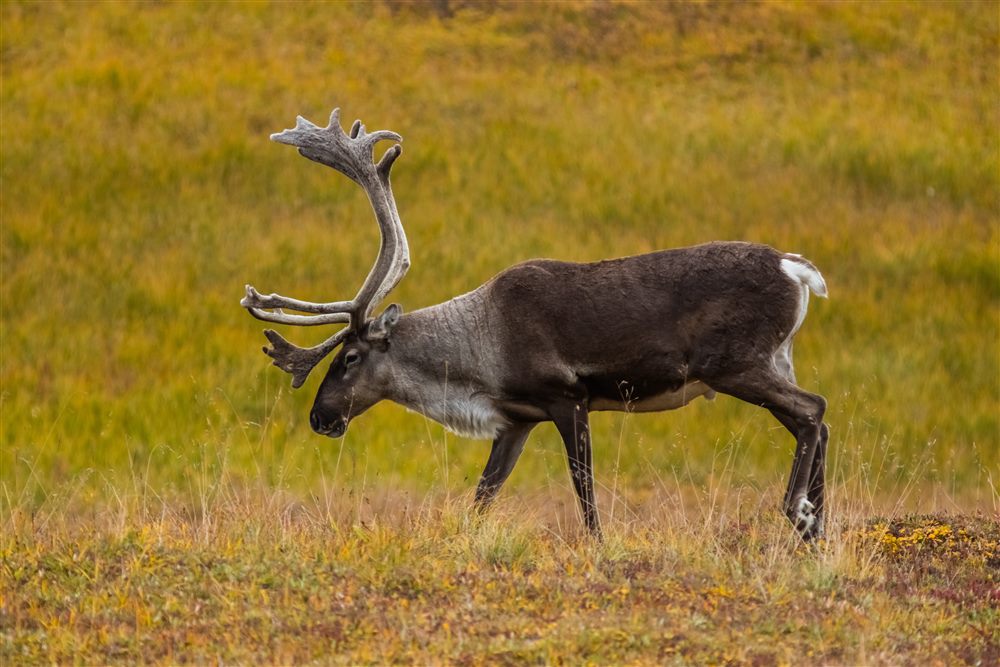
What if it disappeared?
Impact ModerateWithout caribou, the grazing and trampling pressure that currently limits moss from spreading across the tundra vanishes all at once — it's this pressure, documented in decades-long fenced exclusions in Fennoscandia, that keeps the vegetation grassy rather than mossy.
ExtrapolatedDetail
Extrapolation à partir d'Olofsson, Stark & Oksanen (2004), qui documentent l'« hypothèse de l'herbivore clé de voûte » sur des exclos de plusieurs décennies, sans mesurer l'effet à l'échelle d'une seule année.
By comparing plots fenced for decades against normally grazed plots, the study shows that intensive reindeer/caribou grazing can, on its own, tip the tundra from mossy heath to a more productive grassy state. Removing that grazing should therefore, from year one, lift the pressure that keeps moss from regaining ground — even though the study itself only measures this effect after several decades, not after a single season.
What's missing to confirm it: No vegetation measurement exists at the one-year scale after grazing is removed — the studied exclosures date back decades.
Within a few years, another link in the chain would already be shifting: caribou make up most of the Arctic wolf's diet in several regions, where wolf reproduction is directly regulated by caribou abundance — their disappearance would likely trigger a corresponding decline in the wolves most closely dependent on them.
ExtrapolatedDetail
Extrapolation à partir de la littérature générale sur la dynamique loup-caribou en Arctique (Klaczek et al. 2016, Journal of Wildlife Management ; synthèses sur le loup arctique) et des données de gestion du troupeau de la Porcupine.
One indirect signal of this dependency: across the Porcupine herd's range, the winter of 2024, with no reduction in wolf populations, coincided with a calf recruitment rate that fell to 14% — a sign that the predator-prey relationship there is already closely monitored and managed in the opposite direction (protecting caribou from wolves), not yet documented in the direction this entry is interested in (the effect of caribou on wolves if caribou were to become scarce).
What's missing to confirm it: A study isolating the specific effect of caribou abundance — rather than Arctic ungulates in general — on the demographics and reproduction of the wolves most closely dependent on them has yet to be established.
The oldest exclusion plots studied in Fennoscandia, some in place for nearly forty years, already show a tundra shifted toward moss-dominated dwarf-shrub heath, with slowed nutrient cycling. Over a century — more than twice that span — this state would likely be even more firmly entrenched, with nothing left to push the tundra back the other way.
ExtrapolatedDetail
Extrapolation à partir d'Olofsson, Stark & Oksanen (2004), dont les exclos les plus longs couvrent près de quarante ans — projeté ici sur un siècle, soit plus du double de la durée réellement mesurée.
The study itself covers fences in place for 'nearly 40 years' at the time of the survey — the longest real data point available in the sources gathered here, not the full century of this horizon. The reasoning assumes the trend already measured over four decades continues, absent any new mechanism that would reverse it, out to a century — a reasonable but directly untested assumption over that span.
What's missing to confirm it: No direct measurement of tundra state exists beyond roughly forty years without grazing — the extension to a century is a projection of the already-observed trend.
Over a thousand years, another herbivore might come to take on part of the caribou's role — but none matches its movements across hundreds of kilometers or the size of its migratory herds. The tundra would likely remain mossier and less productive than it was with caribou, and the Arctic wolves that depended on it most closely would long since have turned to other prey — a reconfigured Arctic rather than a simple reversal, even if caribou were to return.
HypothesisDocumentation
-
NOAA — 2024 Arctic Report Card: Migratory Arctic caribou populations have fallen by 65%
Accessed August 7, 2026
-
Olofsson, Stark & Oksanen (2004) — Reindeer influence on ecosystem processes in the tundra, Oikos
Accessed August 7, 2026
-
Gouvernement du Yukon — Ecology and Management of Wolves in the Porcupine Caribou Range
Accessed August 7, 2026
Last verified: August 16, 2026