Species → Gray Wolf
Gray Wolf
Canis lupus
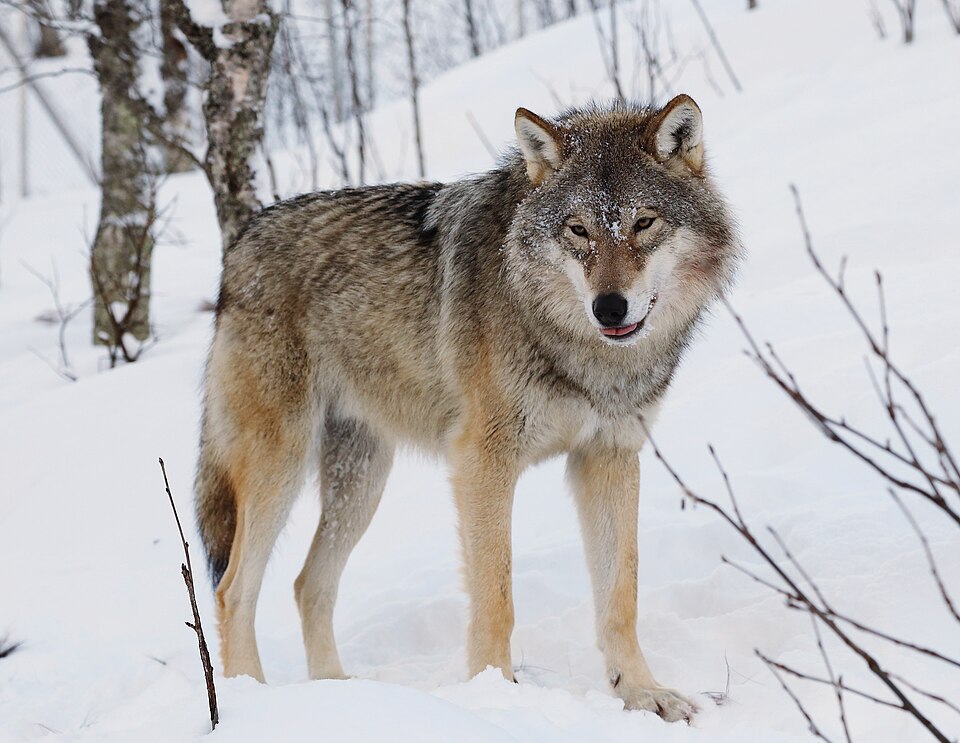
The gray wolf is the most studied trophic cascade in the world: its reintroduction at Yellowstone in 1995 showed how the mere fear it instills in elk and bison can return young willows and aspens to the forest. Its IUCN status is Least Concern globally, but it now occupies only about two-thirds of its historical range. This entry tells what its disappearance would change, separating what studies observed at Yellowstone from what remains extrapolated.
What if it disappeared?
Impact HighWithout wolves, elk and bison almost immediately stop being afraid: they graze calmly through the same valleys, never lifting their heads to check their surroundings. That's the exact opposite of what was seen at Yellowstone within the first two years after wolves returned in 1995, when their vigilance shot up right away.
DocumentedDetail
Laundré, J.W., Hernández, L. et Altendorf, K.B. (2001). Wolves, elk, and bison: reestablishing the "landscape of fear" in Yellowstone National Park, U.S.A. Canadian Journal of Zoology, 79(8), 1401–1409.
Within the first two years after wolf reintroduction (winter 1995–1996), female elk and bison showed significantly higher vigilance in areas at risk of predation than in wolf-free areas — proof, by contrast, that their absence leaves prey less on guard. This is what the authors call the "landscape of fear": the predator's presence changes prey behavior even before direct predation changes their numbers.
That calm comes at a cost to the forest: without the fear that keeps them moving, elk and bison graze the same young willows and aspens over and over, which never grow past a few centimeters. That's exactly what reversed in the fifteen years following the wolves' return to Yellowstone: those same trees finally started growing again in several parts of the park.
DocumentedDetail
Ripple, W.J. et Beschta, R.L. (2012). Trophic cascades in Yellowstone: The first 15 years after wolf reintroduction. Biological Conservation, 145(1), 205–213.
Lighter elk browsing allowed woody species to regain height and cover in part of the park — a real but non-uniform effect across the territory, measured over the first fifteen years after the wolf's return. The authors also note an increase in beaver and bison populations over the same period, plausibly linked to the resurgence of available woody plants and herbaceous forage.
Wolves actually vanished from Yellowstone in 1926 and didn't return until 1995 — nearly seventy years of absence, almost a century. That relentless grazing likely kept the same willows and aspens from growing throughout those decades: wolves came back to a landscape nearly stripped of young trees.
ExtrapolatedDetail
Extrapolation à partir du fait historique de l'extirpation du loup à Yellowstone en 1926 et de sa réintroduction en 1995, combiné à Ripple & Beschta (2012), qui mesurent le regain de végétation ligneuse après le retour du loup sans documenter précisément l'état de la végétation durant les décennies d'absence elles-mêmes.
The wolf's extirpation from Yellowstone in 1926 and its reintroduction in 1995 are well-established historical facts. The willow and aspen regrowth measured by Ripple & Beschta (2012) after 1995 only makes sense by contrast with an earlier state degraded by intense, prolonged browsing — that reference state, plausible but not precisely quantified in the sources gathered here, underlies this point.
What's missing to confirm it: No precise, quantified measurement of vegetation and beaver population state during the seven decades without wolves (1926-1995) was found in the sources gathered here — only the regrowth after their return is directly measured.
Over a thousand years without wolves, this would no longer be a simple growth delay. Smaller predators already present, like coyotes, would likely take on part of their role — but without ever recreating the same fear in the herds. Young trees would get a chance to grow in some places, never everywhere: a landscape left permanently patchy, rather than the dense forest wolves would have maintained.
HypothesisDocumentation
-
IUCN Red List — Canis lupus, statut et population mondiale
Accessed August 6, 2026
-
Laundré, Hernández & Altendorf (2001) — Wolves, elk, and bison: reestablishing the "landscape of fear", Canadian Journal of Zoology
Accessed August 6, 2026
-
Ripple & Beschta (2012) — Trophic cascades in Yellowstone, Biological Conservation
Accessed August 6, 2026
-
International Wolf Center — Yellowstone National Park wolf population declined in 2025
Accessed August 6, 2026
Last verified: August 16, 2026