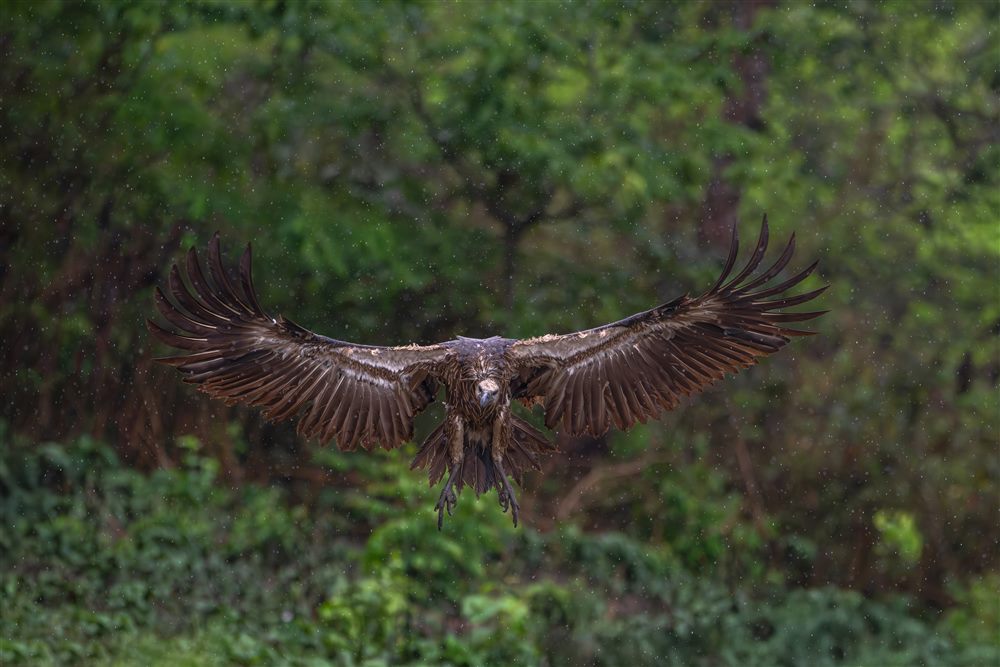
Species → White-rumped Vulture
White-rumped Vulture
Gyps bengalensis
What if it disappeared?
Impact MajorWithout vultures to clear a carcass within hours, it rots in the open or feeds feral dogs whose numbers climb almost immediately — the very mechanism through which the vultures' disappearance spreads diseases like rabies.
DocumentedDetail
Frank, E. et Sudarshan, A. (2024). The Social Costs of Keystone Species Collapse: Evidence from the Decline of Vultures in India. American Economic Review, 114(10), 3007–3040.
The authors identify the precise mechanism behind the rise in human mortality they measure: without vultures, livestock carcasses rot in the open or attract feral dogs, which fuels the spread of diseases including rabies — aerial carcass disposal replaced by a far less hygienic ground-level one.
A decade after the collapse began — the time it took for the population to crash by more than 99% in the hardest-hit regions — human mortality there rose by more than 4%, roughly 100,000 additional deaths per year.
DocumentedDetail
Oaks, J.L., Gilbert, M., Virani, M.Z. et al. (2004). Diclofenac residues as the cause of vulture population decline in Pakistan, Nature ; Frank, E. et Sudarshan, A. (2024). The Social Costs of Keystone Species Collapse, American Economic Review.
By comparing changes in human mortality in regions once highly favorable to vultures against regions where they were already scarce, Frank and Sudarshan isolate the causal effect of their disappearance: about half a million additional deaths in total over the period, for a social cost estimated at $69.4 billion a year. An earlier, methodologically less rigorous estimate had put this cost at about $34 billion cumulative between 1993 and 2006 (Markandya et al., 2008) — the gap between the two shows how much the estimate has been refined with better methods, not that the phenomenon worsened.
Over a century, even if the vulture population had eventually recovered, the ecosystem it returned to would likely no longer be quite the one it left: the feral dogs and other scavengers that filled the gap for decades would have had time to become firmly established, and the way carcasses and slaughterhouse waste are managed would likely have changed in response to their absence.
HypothesisOver a thousand years, the lesson of diclofenac would likely have permanently changed how human societies regulate veterinary medicines near large scavengers — but the exact role vultures played, able to strip a carcass clean within tens of minutes with dozens of individuals descending on it at once, would likely never be recreated exactly by whatever species had replaced them in the meantime.
HypothesisDocumentation
-
IUCN Red List — Gyps bengalensis, statut et population
Accessed August 7, 2026
-
Oaks et al. (2004) — Diclofenac residues as the cause of vulture population decline in Pakistan, Nature
Accessed August 7, 2026
-
Frank & Sudarshan (2024) — The Social Costs of Keystone Species Collapse, American Economic Review
Accessed August 7, 2026
-
Markandya et al. (2008) — Counting the cost of vulture decline, Ecological Economics
Accessed August 7, 2026
-
Prakash et al. (2012) — The population decline of Gyps vultures in India and Nepal has slowed, PLOS ONE
Accessed August 7, 2026
Last verified: August 16, 2026