Species → Lowland Tapir
Lowland Tapir
Tapirus terrestris
What if it disappeared?
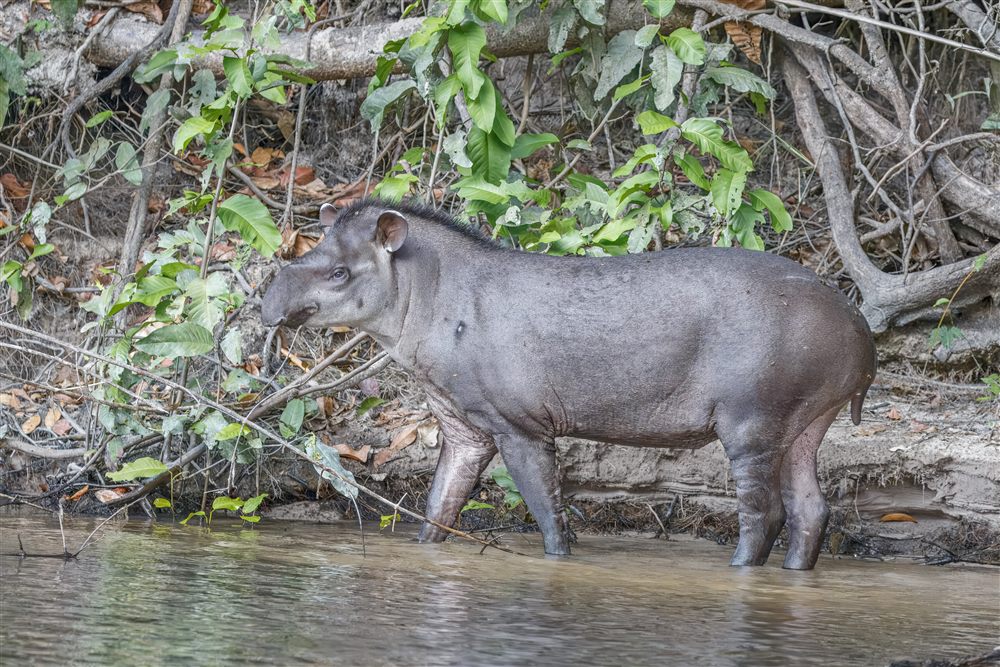
Impact HighBy swallowing whole fruit and then defecating at latrines up to 2 km from the source palms, the tapir shields seeds from a specialized weevil from the very first fruiting season: 77% of seeds left near the parent tree are destroyed by the insect, compared with just 0.7% of those deposited at tapir latrines.
DocumentedDetail
Fragoso, J.M.V. (1997). Tapir-generated seed shadows: scale-dependent patchiness in the Amazon rain forest. Journal of Ecology, 85(4), 519–529.
The study focuses on the large-seeded palm Maximiliana maripa in the Amazon forest of Maracá Island (Roraima, Brazil), tracking 6,140 seeds in total. The weevil Pachymerus cardo, a specialist on this seed, is markedly less active far from adult palm stands — the distance created by tapir transport alone is enough to drop predation from 77% to under 1%.
That seed-level advantage carries over to the forest within a few years: seedling and sapling densities are significantly higher at tapir latrines than around parent trees — the species shapes, year after year, the spatial distribution of the palm it disperses.
DocumentedDetail
Fragoso, J.M.V., Silvius, K.M. et Correa, J.A. (2003). Long-distance seed dispersal by tapirs increases seed survival and aggregates tropical trees. Ecology, 84(8), 1998–2006.
By extending the 1997 tracking through germination and the seedling stage, the authors show that the seed-survival advantage at latrines does translate into more actual plant recruitment — not just fewer seeds eaten. This second link, from seed survival rate to the realized distribution of adult trees, is the one most often missing from wildlife seed-dispersal studies.
If this recruitment gap holds over a century, the palm's distribution would remain durably locked into clumps near parent trees rather than spread across the forest: a plausible effect when extending the trend measured over a few years, but never tracked at the scale of an entire forest stand.
ExtrapolatedDetail
Extrapolation à partir de Fragoso (1997) et Fragoso, Silvius & Correa (2003) : le raisonnement prolonge sur un siècle un écart de recrutement mesuré sur quelques années, sans suivi à l'échelle du peuplement forestier complet.
Both Maracá studies measure a clear survival and recruitment gap over a scale of a few years. Nothing guarantees that gap stays the same over a century — competition among seedlings, other dispersers present, or natural canopy dynamics could dampen or amplify it — but no study has tracked this stand over such a long period to settle the question.
What's missing to confirm it: No stand-scale monitoring over decades to a century confirms whether the recruitment gap measured in the short term translates into a durably clumped palm distribution.
Over a thousand years, other animals able to swallow these large seeds — smaller mammals or large frugivorous birds — would likely take on part of the tapir's dispersal role, but over distances far shorter than its 2 km latrine-to-latrine range. The palm would probably survive, but in a landscape of closer, less intermixed clumps than the one the tapir used to shape.
HypothesisDocumentation
-
IUCN Red List — Tapirus terrestris, statut de conservation
Accessed August 14, 2026
-
Fragoso (1997) — Tapir-generated seed shadows: scale-dependent patchiness in the Amazon rain forest, Journal of Ecology
Accessed August 14, 2026
-
Fragoso, Silvius & Correa (2003) — Long-distance seed dispersal by tapirs increases seed survival and aggregates tropical trees, Ecology
Accessed August 14, 2026
Last verified: August 16, 2026