Species → Passenger pigeon
Passenger pigeon
Ectopistes migratorius
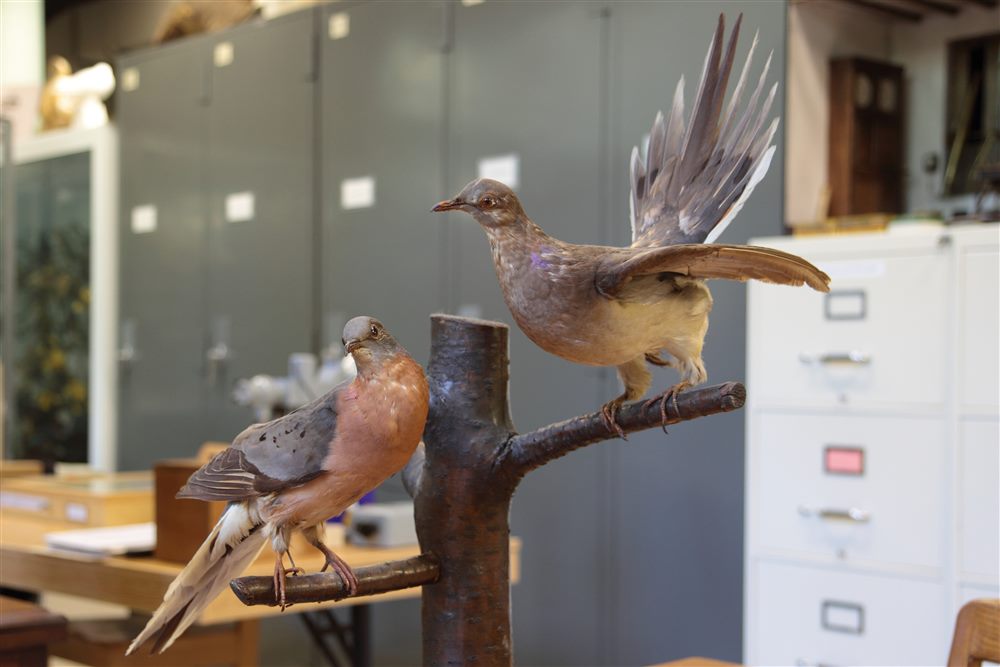
What if it disappeared?
Impact HighThe year after the passenger pigeon's disappearance, the deciduous forests of eastern North America stop experiencing the massive disturbance its nesting colonies — up to a hundred million birds across several hundred square kilometers — inflicted on them every year: broken branches, huge deposits of droppings on the ground.
ExtrapolatedDetail
Ellsworth, J.W. & McComb, B.C. (2003). Potential Effects of Passenger Pigeon Flocks on the Structure and Composition of Presettlement Forests of Eastern North America. Conservation Biology, 17(6), 1548–1558.
A single documented colony in Wisconsin in 1871 covered about 850 square miles (2,200 km²) and numbered, according to naturalist A.W. Schorger's estimate, about 136 million breeding adults. The authors themselves present this effect as a reconstruction from historical accounts and forest-ecology principles, not a direct measurement — the species went extinct before trophic cascade ecology existed as a discipline. That this disturbance stopped cold the year after Martha's death in 1914 follows directly from the fact that the colonies never reformed.
What's missing to confirm it: No experimental study can measure this effect directly anymore since the species is extinct; any further confirmation could only come from paleoecology (charcoal, pollen) at known historical colony sites.
In the decade that follows, the white oak's advantage — its acorns germinate in fall, escaping the pigeons' spring acorn predation, unlike the red oak which germinates in spring — would lose its reason to exist: nothing would still stop young red oaks from establishing just as well as white ones.
ExtrapolatedDetail
Extrapolation à partir d'Ellsworth & McComb (2003), qui proposent l'hypothèse que la germination automnale du chêne blanc lui permettait d'échapper à la prédation printanière des glands par le pigeon migrateur, contrairement au chêne rouge — sans mesurer ce qui arrive à cet avantage une fois le pigeon disparu.
The authors propose this hypothesis to explain the white oak's historic dominance in regions the species frequented, without verifying it through field monitoring. If the hypothesis holds, the pigeon's disappearance removes at a stroke the pressure that favored white oak over red oak — an advantage that would then have no reason to persist in new generations of seedlings, even though no study tracked seedling composition in the decade after 1914 to confirm it.
What's missing to confirm it: No monitoring of seedling composition (white oak versus red oak) from the 1910s-1920s was found to confirm that this advantage actually began to fade as fast as it disappeared as a selective pressure.
A century later, the forest that regrew across the pigeon's historic range would likely carry few distinct traces of its absence: the logging and conversion to farmland that swept eastern North America through the 20th century probably erased any signature specific to the passenger pigeon, overwhelmed by disturbances of an entirely different scale.
HypothesisUnlike a species that simply became scarce, an extinction never reopens: a thousand years would not be enough to bring back a colony of a hundred million birds able to disturb several hundred square kilometers of forest in one stroke. That extremely large-scale, time-concentrated form of disturbance would remain absent from eastern North America's forests forever, for lack of any living species able to reproduce it at that scale.
HypothesisDocumentation
-
Ellsworth & McComb (2003) — Potential Effects of Passenger Pigeon Flocks on the Structure and Composition of Presettlement Forests, Conservation Biology
Accessed August 7, 2026
-
Burke Museum — From billions to none: The passenger pigeon
Accessed August 7, 2026
-
Smithsonian — Marking the Centennial of Extinction
Accessed August 7, 2026
Last verified: August 16, 2026