Species → Temminck's Ground Pangolin
Temminck's Ground Pangolin
Smutsia temminckii
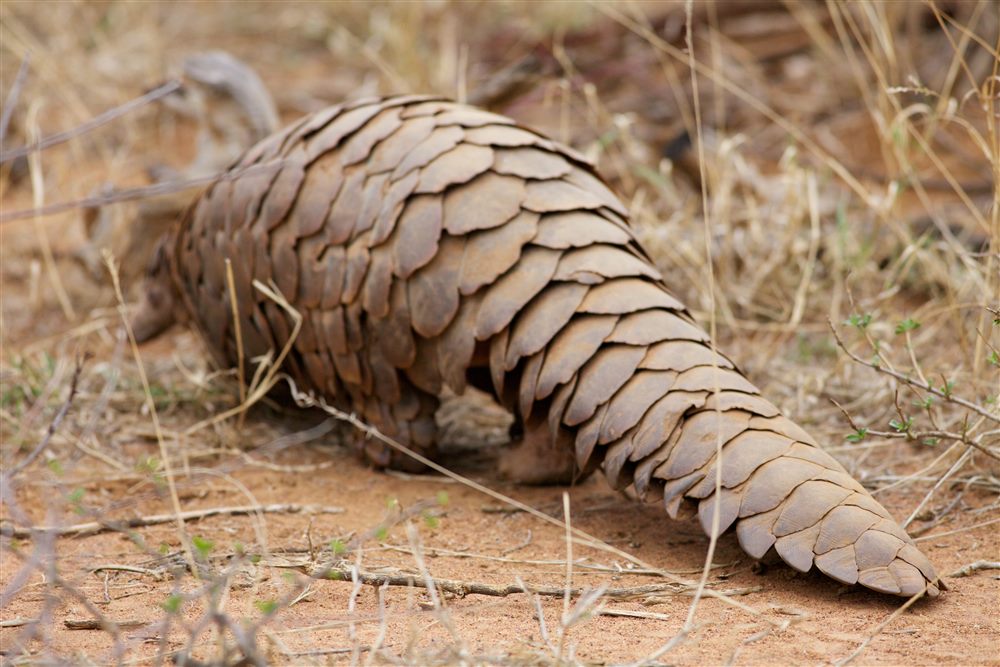
What if it disappeared?
Impact ModerateTemminck's pangolin doesn't eat at random: it targets only 4 ant species and a single termite species, which it can swallow by the tens of thousands in a single night. Its disappearance would remove this highly targeted predation pressure almost immediately, and the colonies of those specific species would start growing unchecked.
ExtrapolatedDetail
Extrapolation à partir de Pietersen et al. (2016), qui documente la sélectivité alimentaire de l'espèce, et de Panaino et al. (2022), qui mesure jusqu'à 60 000 proies ingérées par nuit — aucune étude ne mesure directement la croissance des colonies de fourmis et de termites en l'absence du pangolin.
Pietersen et al. (2016) show that the pangolin actively selects 4 ant species (7.5% of those present on its range) and a single termite species (25% of those present) rather than feeding at random on whatever is available. Panaino et al. (2022) put this pressure at roughly 15,000 prey per night on average, up to 60,000. Removing this highly selective predator should logically relieve those specific colonies first, though no study has yet measured that release directly.
What's missing to confirm it: Monitoring of the four targeted ant species and the targeted termite species in an area where the pangolin has disappeared, to confirm their populations actually grow without it.
Over ten years, the termite colony the pangolin used to target would likely grow substantially without the control it exerted over it. Termites dig tunnels that help water soak into dry soil: their proliferation would likely change soil texture and moisture in the areas the pangolin used to hunt, an effect reaching beyond insects alone.
HypothesisOver a century, this imbalance would likely have settled into a new state: the handful of ant and termite species once kept in check would durably dominate the soil insect community, at the expense of less conspicuous species they would eventually have outcompeted.
HypothesisOver a thousand years, another myrmecophage in the region, like the aardvark, would likely fill part of the gap left behind — but without the same extreme selectivity for those exact species. The soil insect community would likely carry a lasting fingerprint, different from the one a still-present pangolin would have maintained.
HypothesisDocumentation
-
IUCN Red List — Smutsia temminckii, statut de conservation
Accessed August 14, 2026
-
Panaino et al. (2022) — Do seasonal dietary shifts by Temminck's pangolins compensate for winter resource scarcity in a semi-arid environment?, Journal of Arid Environments
Accessed August 14, 2026
-
Pietersen et al. (2016) — Diet and prey selectivity of the specialist myrmecophage, Temminck's ground pangolin, Journal of Zoology
Accessed August 14, 2026
-
TRAFFIC — Nearly 900,000 pangolins trafficked worldwide (couverture Phys.org de l'analyse TRAFFIC)
Accessed August 14, 2026
Last verified: August 16, 2026