Species → Atlantic Cod
Atlantic Cod
Gadus morhua
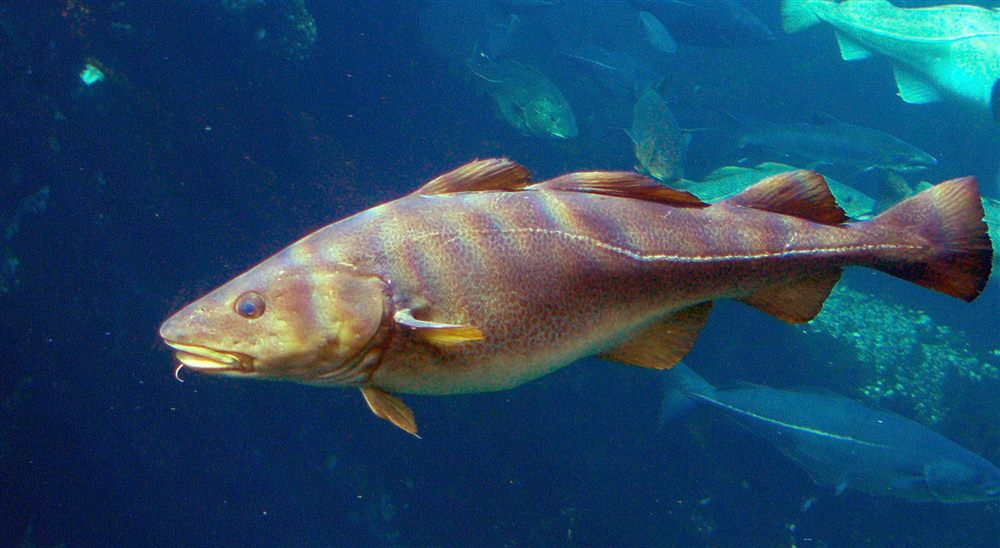
What if it disappeared?
Impact MajorOnce cod is removed en masse, the predation it exerted on small pelagic fish — herring, sand lance — stops immediately: it's this instant release that sets off, in the years that follow, the entire trophic cascade later measured on the Scotian Shelf.
ExtrapolatedDetail
Extrapolation à partir de Frank, K.T., Petrie, B., Choi, J.S. et Leggett, W.C. (2005). Trophic cascades in a formerly cod-dominated ecosystem. Science, 308(5728), 1621–1623 — l'étude documente la cascade trophique résultante sur plusieurs décennies de données, sans isoler la vitesse à laquelle la pression de prédation s'est relâchée dès la première année suivant le retrait de la morue.
Predation by one fish on another stops by definition the moment the predator is gone — an immediate release by construction. What the study does not measure is how fast pelagic fish populations began growing in response: it documents the cumulative state of the cascade after several years of monitoring data, not its precise onset.
What's missing to confirm it: No measurement isolated to the first year after the collapse confirms exactly how fast pelagic fish populations began growing — only the cumulative state after several years is directly measured.
Within a few years, the entire food chain beneath cod tipped into cascade: the small pelagic fish it fed on proliferated, the zooplankton those fish feed on collapsed, and at the level below that, phytoplankton increased while available nitrates declined.
DocumentedDetail
Frank, K.T., Petrie, B., Choi, J.S. et Leggett, W.C. (2005). Trophic cascades in a formerly cod-dominated ecosystem. Science, 308(5728), 1621–1623.
The study draws on several decades of monitoring data on the Scotian Shelf (Canadian Northwest Atlantic). Before the collapse, cod and other large groundfish dominated the ecosystem and kept populations of small pelagic fish (such as sand lance and herring) at a low level. Their massive removal through overfishing triggered a four-level trophic cascade — one of the rare documented cases of such a cascade at the scale of an open marine ecosystem rather than in a closed or coastal system.
This shift has not eased with time: more than twenty years after fishing stopped, the now-abundant small pelagic fish are devouring cod eggs and larvae, actively locking the ecosystem into its new state — a mechanism that, extended over a century, would likely keep the Scotian Shelf in this reversed configuration, unless the more recent decline of those same pelagic fish, starved of zooplankton, eventually loosens the lock.
ExtrapolatedDetail
Frank, K.T., Petrie, B., Fisher, J.A.D. et Leggett, W.C. (2011). Transient dynamics of an altered large marine ecosystem. Nature, 477, 86–89, et extrapolation de cette même étude à l'échelle du siècle, sur la base du déclin des poissons pélagiques et de la hausse du zooplancton de grande taille qu'elle documente sur la même période.
The study documents a precise mechanism explaining the lack of recovery despite more than two decades of moratorium: pelagic fish (herring, sand lance, capelin), grown abundant after their predator's disappearance, now consume cod eggs and larvae en masse — reversing the predator-prey role that prevailed before the collapse, what the authors call a 'runaway' consumption dynamic that locks the ecosystem into its new state. The authors also note a rising trend in large-bodied zooplankton, which they themselves describe as a still-uncertain signal rather than a confirmed recovery — projecting this lock-in across a full century assumes no other factor interrupts it in the meantime.
What's missing to confirm it: No published follow-up since confirms whether this zooplankton rebound has translated into a measurable increase in cod biomass on the Scotian Shelf specifically, or whether the lock-in would truly hold for a full century — unlike the separate northern Newfoundland stock, where a recovery has indeed been measured after 32 years.
Even if cod eventually returned — like the separate northern Newfoundland stock, back to a healthy zone after a 32-year moratorium — nothing guarantees the Scotian Shelf would regain its ecosystem's original makeup: a population reduced for so long likely loses part of its genetic diversity, and the reversed predator-prey relationships that would have taken hold through all that time without cod would likely leave a lasting mark, even after its return.
HypothesisDocumentation
-
IUCN Red List — Gadus morhua, évaluation 1996 (Vulnerable, en attente de mise à jour)
Accessed August 7, 2026
-
Frank, Petrie, Choi & Leggett (2005) — Trophic cascades in a formerly cod-dominated ecosystem, Science
Accessed August 7, 2026
-
Frank, Petrie, Fisher & Leggett (2011) — Transient dynamics of an altered large marine ecosystem, Nature
Accessed August 7, 2026
-
DFO — Assessment of the Northern Cod (Gadus morhua) stock in NAFO Divisions 2J3KL, 2024-2025
Accessed August 7, 2026
Last verified: August 16, 2026