Species → Black-footed ferret
Black-footed ferret
Mustela nigripes
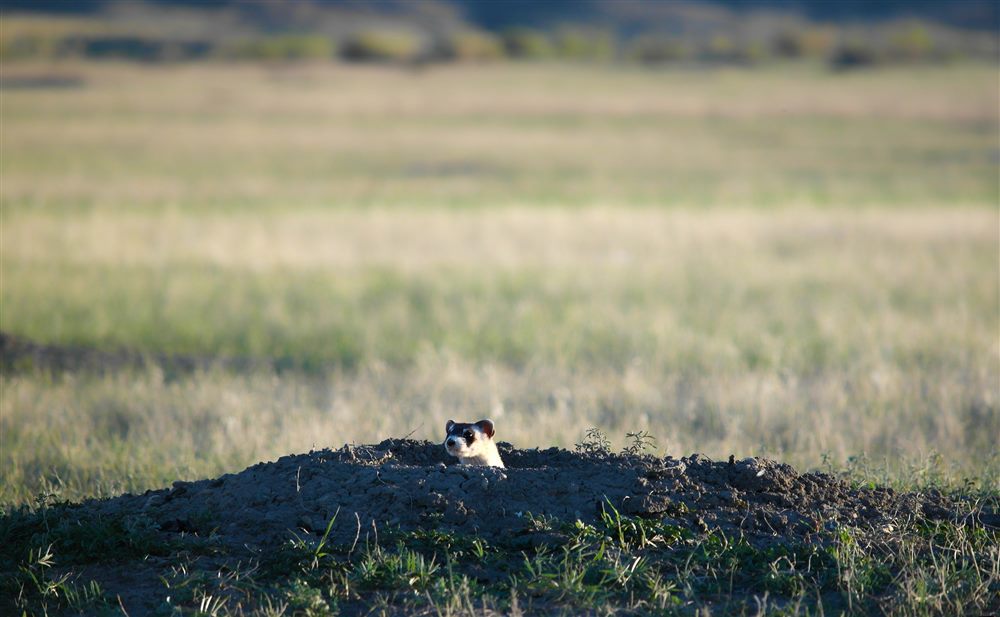
What if it disappeared?
Impact LowIf the ferret vanished from a prairie dog colony it occupies today, nothing would likely be visible within the first year: its predation represents only a tiny fraction of what already threatens these colonies — sylvatic plague and, historically, rancher poisoning weigh far more heavily than this small specialist predator on year-to-year prairie dog numbers.
HypothesisAcross several years of reintroduction monitoring, the ferret's presence has never been observed to collapse a prairie dog colony it occupied — indirect evidence that its predation doesn't strongly limit these colonies. If its presence doesn't push them down, its absence probably wouldn't push them up much either: the main factor governing their numbers would remain sylvatic plague, not this predator.
ExtrapolatedDetail
Extrapolation à partir des données de suivi des programmes de réintroduction (U.S. Fish & Wildlife Service ; Arizona Game and Fish Department, communiqué de mars 2026 sur la relâche de 19 individus sur trois sites du nord de l'Arizona).
Colonies where the ferret was reintroduced and persisted for several years have shown no decline attributable to its predation — an indirect signal, since no one has directly compared colonies with and without ferrets. Sylvatic plague remains the dominant factor identified in these same monitoring efforts, affecting both species independent of their predator-prey relationship.
What's missing to confirm it: A direct comparison of colonies with and without ferrets, controlling for sylvatic plague, is still lacking to confirm that its predation has a genuinely negligible effect rather than simply an unmeasured one.
Over a century, a prairie dog colony would likely be shaped far more by historical rancher poisoning and by sylvatic plague than by the presence or absence of this small specialist predator: both forces already drove colonies and ferrets down together throughout the 20th century, at a scale predation alone could never have approached.
HypothesisOver a thousand years, if the ferret disappeared for good, other small predators already present on the same prairies — badgers, coyotes, raptors — would likely divide up the share it once held, without ever replicating its near-exclusive dependence on the prairie dog, which supplied over 90% of its diet and even its shelter. The prairie dog colony would probably do just fine without it, but would lose a predator of a kind nothing else quite replaces.
HypothesisDocumentation
-
U.S. Fish & Wildlife Service — Black-footed Ferret (Mustela nigripes)
Accessed August 7, 2026
-
Prey selection by black-footed ferrets: implications for intersexual resource partitioning and conservation, Journal of Mammalogy
Accessed August 7, 2026
-
Defenders of Wildlife — Black-footed Ferret, statut et population
Accessed August 7, 2026
Last verified: August 16, 2026