Species → Ochre sea star
Ochre sea star
Pisaster ochraceus
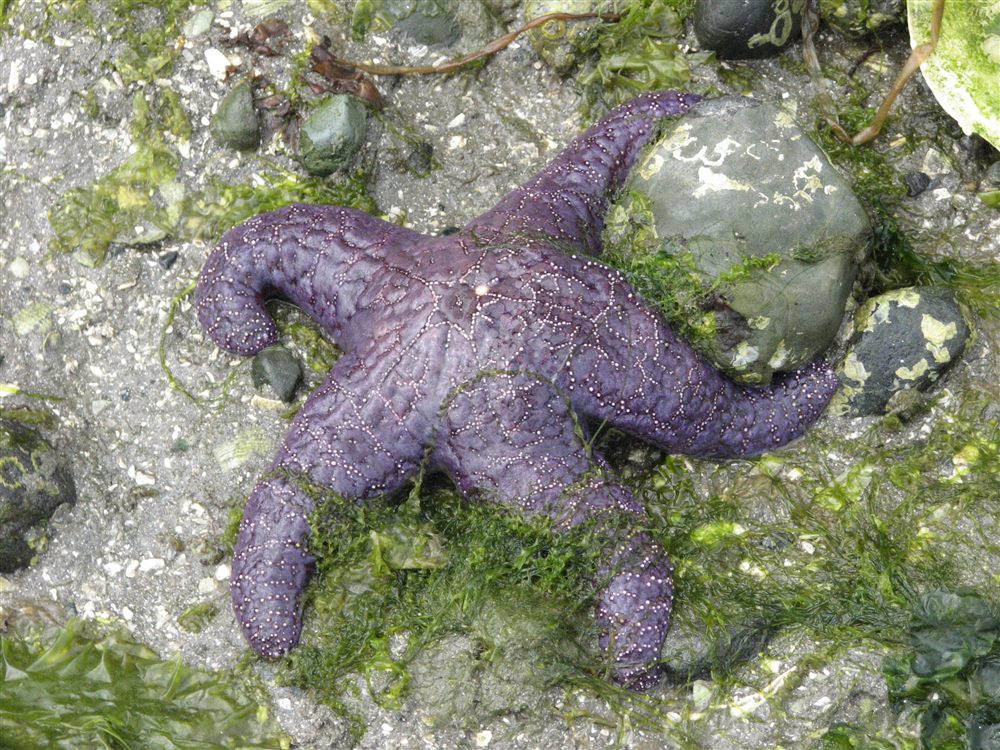
The ochre sea star is the species that gave the keystone-species concept its name: Robert Paine's experiments on the rocky shore showed that removing it let the mussel Mytilus californianus take over open space. It is not assessed by the IUCN, but its regional decline is real since the 2013-2015 wasting-disease epidemic, with uneven recovery across sites. This entry documents, from one year to a thousand, what its absence would do to an entire rocky coastline.
What if it disappeared?
Impact MajorWithout a sea star to keep it in check, the mussel Mytilus californianus takes over open space: within three years, on intertidal plots where Paine removed the sea star, the number of species present dropped from 15 to 8.
DocumentedDetail
Paine, R.T. (1966). Food Web Complexity and Species Diversity. The American Naturalist, 100(910), 65–75.
By experimentally removing the ochre sea star from plots of rocky intertidal shore and comparing them to control plots, Paine showed that the mussel, the sea star's main prey, comes to monopolize the available space within three years, crowding out seven other rock-attached species. This is the founding experiment behind the keystone species concept.
Decades later, that same site remains dominated by the mussel, now an almost continuous mat — the takeover Paine observed was not temporary, even though total diversity otherwise stays high, carried by the worms and small crustaceans living within the mussel bed itself.
DocumentedDetail
Lafferty, K.D. et Suchanek, T.H. (2016). Revisiting Paine's 1966 Sea Star Removal Experiment, the Most-Cited Empirical Article in the American Naturalist. The American Naturalist, 188(4), 365–378.
This revisit of Paine's experimental site, several decades later, confirms that over the long term, with the sea star durably absent, the mussel eventually forms an almost continuous mat — even though, when counting the species living within the mussel bed itself (worms, small crustaceans), the site's total diversity otherwise remains high.
A century after a complete disappearance, that mussel takeover would likely have spread across an entire rocky shoreline rather than a few plots: the wasting-disease epidemic underway since 2013 has already driven sea star density down by 59 to 90% across large stretches of the Pacific coast — at a scale far beyond the plots Paine studied.
ExtrapolatedDetail
Extrapolation à partir de Paine (1966), Lafferty & Suchanek (2016) et de l'ampleur réelle de l'épidémie de dépérissement de 2013-2015 sur la côte Pacifique — combine une expérience de retrait à petite échelle avec un déclin réel à grande échelle, sans confirmation directe que la prise de contrôle par la moule se reproduit identiquement à cette échelle régionale.
Wasting disease caused sea star density and biomass to drop by 59 to 90% depending on the site between 2013 and 2014, with recovery very uneven across regions (better in Oregon and northern California than in Alaska and Washington). If this regional-scale decline persisted, the mechanism Paine measured over a few square meters would play out across hundreds of kilometers of coastline.
What's missing to confirm it: No one has confirmed whether the mussel takeover Paine observed at small scale has occurred at the regional scale of this real-world epidemic.
Over a thousand years, even if the ochre sea star returned, the rocky shore probably wouldn't regain the same balance: the mussel would have had ample time to occupy all available space, and the species that once competed with it for rock attachment sites would likely have vanished locally rather than waiting for its return.
HypothesisDocumentation
-
Sea Star Wasting Disease in the Keystone Predator Pisaster ochraceus in Oregon
Accessed August 10, 2026
-
Paine (1966) — Food Web Complexity and Species Diversity, The American Naturalist
Accessed August 7, 2026
-
Lafferty & Suchanek (2016) — Revisiting Paine's 1966 Sea Star Removal Experiment, The American Naturalist
Accessed August 7, 2026
-
Miner et al. (2018) — Large-scale impacts of sea star wasting disease (SSWD) on intertidal sea stars, PLOS ONE
Accessed August 7, 2026
Last verified: August 16, 2026