Species → Tasmanian Devil
Tasmanian Devil
Sarcophilus harrisii
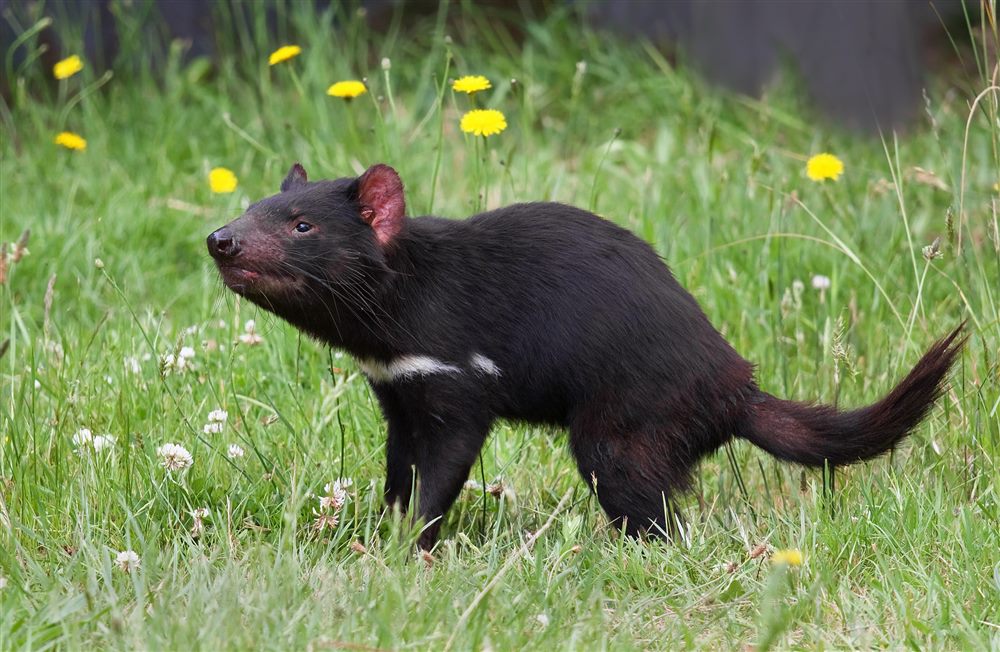
What if it disappeared?
Impact LowIn a region newly reached by devil facial tumour disease, the devil declines there immediately with no sign of recovery — and it is precisely in these regions that feral cat occurrence rises, significantly and negatively associated with devil occurrence.
DocumentedDetail
Hollings, T., Jones, M., Mooney, N. & McCallum, H. (2014). Trophic Cascades Following the Disease-Induced Decline of an Apex Predator, the Tasmanian Devil. Conservation Biology, 28(1), 63–75.
The study draws on spotlighting count data conducted across Tasmania over several decades, both before and after the disease's arrival in each region. Devil decline is immediate in every affected region, with no sign of recovery, and coincides with the rise in feral cat occurrence.
In regions where the disease has been established the longest, that shift carries on to the next link: the eastern quoll — the smallest native mesopredator, once protected by the devil suppressing mid-sized predators — is now declining there rapidly in turn.
DocumentedDetail
Hollings, T., Jones, M., Mooney, N. & McCallum, H. (2014). Trophic Cascades Following the Disease-Induced Decline of an Apex Predator, the Tasmanian Devil. Conservation Biology, 28(1), 63–75.
The smallest of Tasmania's native mesopredators, the eastern quoll, declines fastest precisely in the regions where the devil has been receding the longest — consistent with the gradual loss of the protection it once drew from the devil suppressing mid-sized predators like the feral cat.
If devils remained scarce across the whole island for a century, the same dynamic would likely continue: feral cats more firmly established, and the eastern quoll still declining without the check devils once placed on mid-sized predators.
ExtrapolatedDetail
Extrapolation à partir de Hollings et al. (2014), qui documentent cette association sur plusieurs décennies déjà écoulées, prolongée ici à l'échelle du siècle.
Hollings and colleagues' study already covers several decades of devil decline across regions; extrapolating this same mechanism — devil decline, cat expansion, quoll decline — to a century assumes nothing else reshuffles the picture over such a long span, which the study itself cannot guarantee.
What's missing to confirm it: A study focused specifically on quolls and cats (Fancourt et al., 2015) does not find a clear increase in cat abundance following devil decline, and proposes a different explanation: cats may be hindering the recovery of already-weakened quolls rather than having caused their initial decline. The century-scale trajectory therefore remains actively debated.
Over a thousand years, Tasmania would very likely remain without a large marsupial predator-scavenger the devil's size, a role no other native island species fills. Even if introduced competitors like the feral cat took over part of the space left among small and mid-sized predators, that gap at the very top would never quite close the same way.
HypothesisDocumentation
-
Hollings et al. (2014) — Trophic Cascades Following the Disease-Induced Decline of an Apex Predator, the Tasmanian Devil, Conservation Biology
Accessed August 7, 2026
-
Fancourt et al. (2015) — Devil declines and catastrophic cascades: is mesopredator release of feral cats inhibiting recovery of the eastern quoll?, PLoS ONE
Accessed August 7, 2026
-
Save the Tasmanian Devil Program / synthèses de statut — déclin depuis 1998, statut En danger
Accessed August 7, 2026
Last verified: August 16, 2026