Species → Golden Toad
Golden Toad
Incilius periglenes
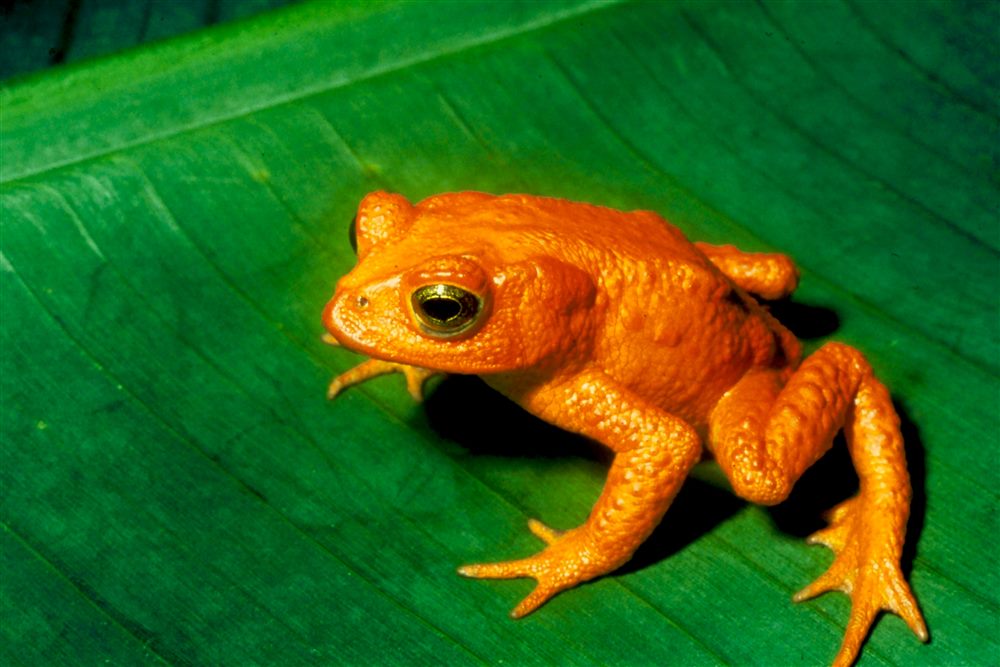
What if it disappeared?
Impact LowBy the very first rainy season after it vanished, the temporary pools in the cloud forest where its tadpoles used to graze on algae would hold none at all — the algae they used to eat would build up unchecked for that one season.
HypothesisRepeated every rainy season for ten years, this buildup of algae and debris in the same pools would likely change the insects and small creatures that develop there — mosquitoes and other larvae would benefit from water richer in organic matter than when tadpoles kept it clean.
HypothesisThe golden toad is not an isolated case: about two-thirds of the harlequin frogs (genus Atelopus) native to tropical America disappeared in the same decade as it did. A century later, a great many of the mountain pools and streams they once inhabited would plausibly still have no tadpole left to keep their algae in check.
ExtrapolatedDetail
Extrapolation à partir de Pounds, Bustamante, Coloma et al. (2006), qui documentent la disparition d'environ deux tiers des grenouilles Atelopus d'Amérique tropicale dans la même décennie que le crapaud doré, pas l'état de leurs mares un siècle plus tard.
Pounds et al. (2006) establish that chytridiomycosis, favored by global warming, wiped out about two-thirds of tropical American Atelopus species in the same decade the golden toad disappeared — a regional-scale loss, not an isolated case. The reasoning extends that finding: if tadpoles keep a mountain pool's algae in check, the simultaneous loss of so many related species across such a wide territory makes it plausible that, a century on, many of those pools would still have no grazer at all.
What's missing to confirm it: No study measures the actual state of these mountain pools a century after an Atelopus disappears locally — the reasoning starts from the regional scale of the decline documented by Pounds et al., not from field monitoring.
Unlike a species only gone from one region, the golden toad is extinct everywhere: no population anywhere could ever recolonize Monteverde. Even a thousand years from now, the niche it once filled in those mountain pools would not return to what it was — there is no one left to take it back up.
HypothesisDocumentation
-
Pounds et al. (2006) — Widespread amphibian extinctions from epidemic disease driven by global warming, Nature
Accessed August 7, 2026
Last verified: August 16, 2026