Species → California Condor
California Condor
Gymnogyps californianus
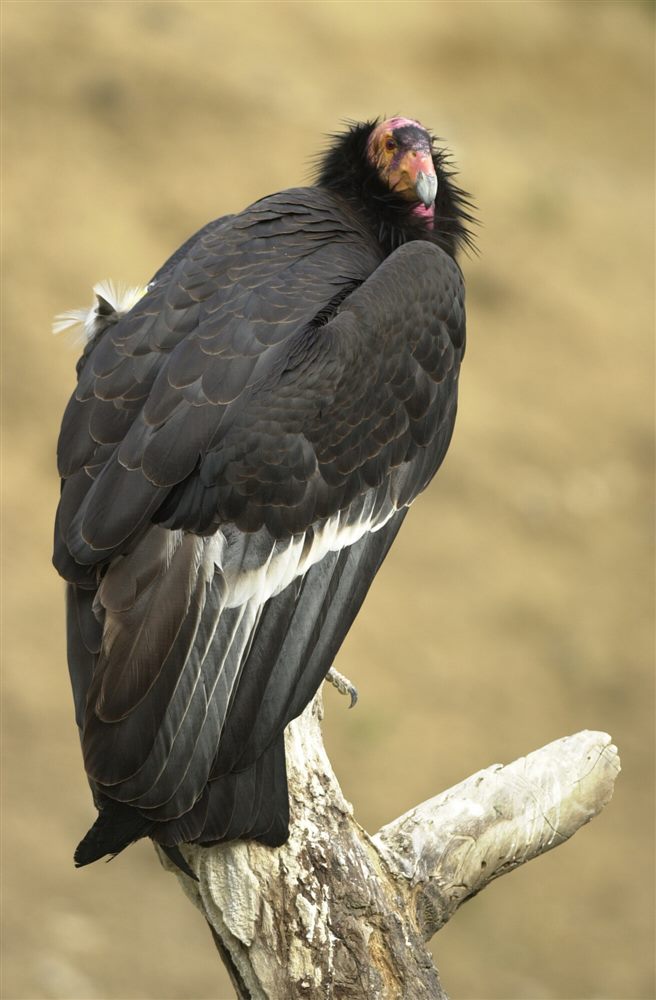
What if it disappeared?
Impact ModerateWithout condors, large carcasses (livestock, deer) first stay intact longer: their beak is one of the few powerful enough to pierce thick hide, a service that used to make the carcass accessible to corvids, foxes, and other small scavengers unable to break into it on their own.
DocumentedDetail
National Park Service — Benefits of Condors, synthèse du rôle écologique du condor de Californie dans les écosystèmes qu'il fréquente.
This 'first opener' role is not interchangeable with that of small scavengers: without a beak powerful enough to pierce the hide, a large carcass can remain intact far longer starting in the very first year without condors, delaying its recycling by the rest of the scavenger community.
Carcasses that open later, and only through decomposition rather than the condor's beak, would also give dangerous bacteria — such as virulent strains of Clostridium perfringens and Shigella — more time to persist and spread in the environment, instead of being destroyed by the condor's extremely acidic digestive tract.
ExtrapolatedDetail
Extrapolation à partir de Jacobs, McMahon, Berendzen et al. (2019), qui documentent la tolérance bactérienne extrême du condor et la destruction des bactéries pathogènes ingérées avec la charogne : le raisonnement étend cet effet individuel à une persistance accrue des bactéries à l'échelle de l'environnement, jamais mesurée directement.
This extreme bacterial tolerance (digestive pH of 1.9, versus 2.9 in humans), documented in captive-bred condors, matches the pattern already observed in other New World vultures: a digestive tract that destroys the vast majority of pathogenic bacteria ingested with carrion. Over ten years without condors, this destructive function stops operating on every large carcass left to decomposition alone.
What's missing to confirm it: No study measures the actual bacterial load of the environment (soil, water) around carcasses not processed by a condor, compared to carcasses it would have consumed.
Over a century, other North American scavengers — turkey vultures, coyotes, black bears — would likely fill part of the gap, but none has the same powerful beak: the largest carcasses would probably stay closed longer across the landscape, a phenomenon comparable to the better-documented collapse of South Asian vultures, though no study has measured it for the condor.
HypothesisOver a thousand years, selective pressure could favor other scavengers evolving a beak or habits better suited to breaching large carcasses, or push the landscape toward decomposition dominated by insects and microbes rather than vertebrates. Even if condors eventually returned, the pace of large-carcass recycling would likely never quite return to what they once provided.
HypothesisDocumentation
-
US Fish & Wildlife Service — 2024/2025 California Condor Population Status Report
Accessed August 7, 2026
-
Jacobs, McMahon, Berendzen et al. (2019) — California condor microbiomes, PLoS ONE
Accessed August 7, 2026
-
National Park Service — Benefits of Condors
Accessed August 7, 2026
-
Finkelstein, Doak, George et al. (2012) — Lead poisoning and the deceptive recovery of the California condor, PNAS
Accessed August 7, 2026
Last verified: August 16, 2026