Species → Helmeted Hornbill
Helmeted Hornbill
Rhinoplax vigil
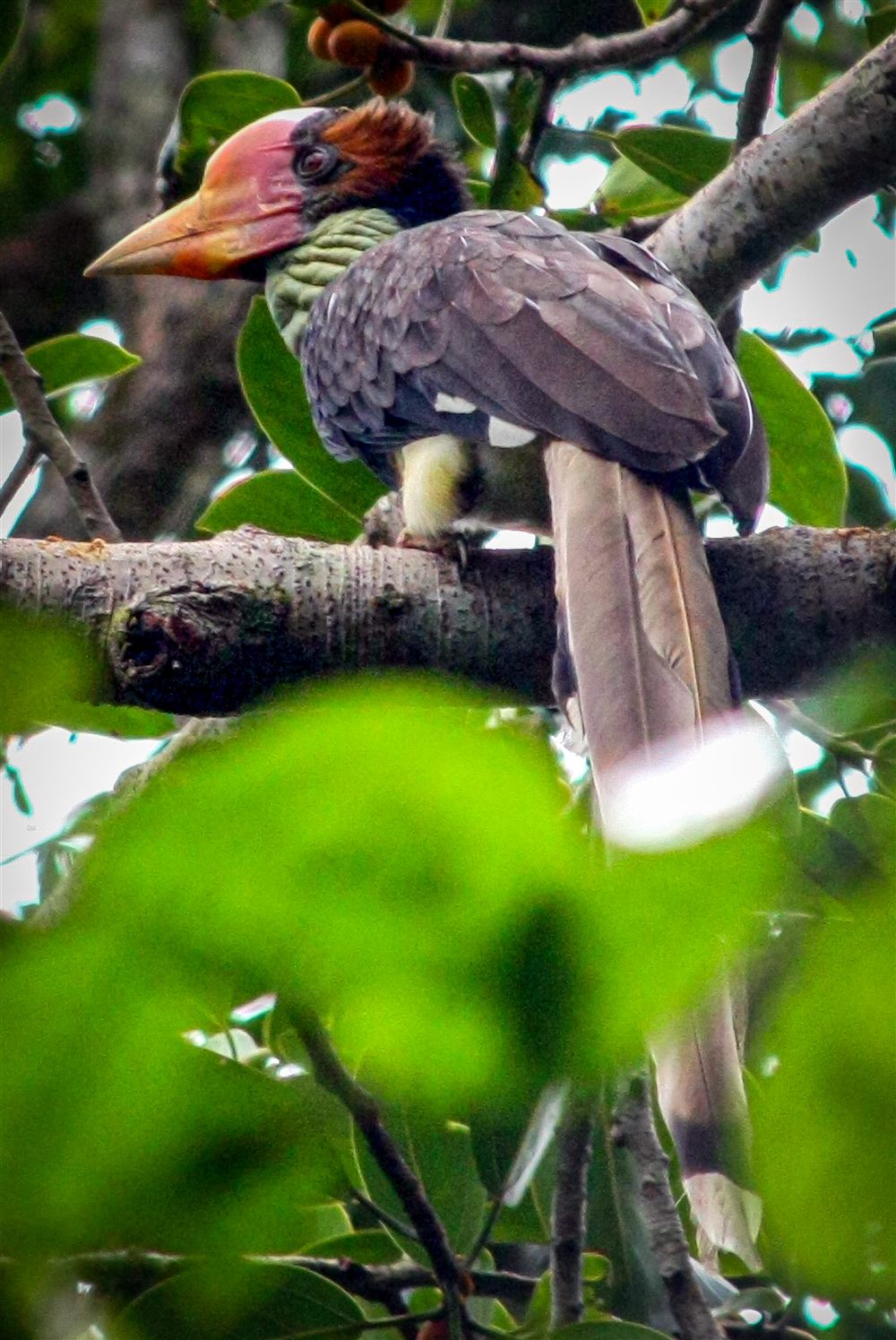
What if it disappeared?
Impact ModerateWithout the hornbill to carry them, the seeds of hemi-epiphytic figs — which germinate perched on a branch before their roots grow down to the ground — stay stuck near the parent tree: the handful that used to reach a distant, germination-friendly branch no longer have any way to get there.
DocumentedDetail
Nakabayashi, M., Inoue, Y., Ahmad, A.H. et Izawa, M. (2019). Limited directed seed dispersal in the canopy as one of the determinants of the low hemi-epiphytic figs' recruitments in Bornean rainforests. PLOS ONE, 14(6), e0217590.
The study measured the hornbill dispersing hemi-epiphytic fig seeds an average of 1,612 m, with 53.3% carried beyond a kilometer — but only 11.8% of deposits landed on a branch, the only microsite where a seed could actually germinate. That long-distance transport capacity, already rare in its success rate, disappears entirely with the bird, right from the first year.
Ten years on, new hemi-epiphytic figs would likely establish almost only right next to their existing host trees: the small share of seeds that used to land, even rarely, on a distant and viable branch vanished along with the only disperser able to carry them that far.
ExtrapolatedDetail
Extrapolation à partir de Nakabayashi et al. (2019), qui mesure la distance et les microsites de dépôt des graines par le calao vivant, pas le devenir du recrutement des figuiers après sa disparition.
The study establishes that only deposits on a branch — 11.8% of the total — offered a real chance of germination, and that more than half of dispersed seeds traveled beyond a kilometer. Without the hornbill, that small stream of seeds toward distant, viable sites stops; only seeds falling near the parent tree by other means (gravity, small animals) would keep feeding recruitment, over a very limited area.
What's missing to confirm it: No study tracks actual hemi-epiphytic fig recruitment at a site following the hornbill's local disappearance, to confirm this slowdown at ten years.
A century after its disappearance, these figs would probably have retreated far from their last host trees, with no animal left able to carry their seeds that far into the canopy — a gap no other known disperser in Borneo's forest would likely fill.
HypothesisOver a thousand years, the forest would likely keep hemi-epiphytic figs clustered in pockets around their historic host trees rather than spread widely through the understory — a permanently patchy plant legacy, even without the fig's complete extinction.
HypothesisDocumentation
-
IUCN Red List — Rhinoplax vigil, statut de conservation
Accessed August 14, 2026
-
Beastall et al. (2016) — Trade in the Helmeted Hornbill Rhinoplax vigil: the 'ivory hornbill', Bird Conservation International
Accessed August 14, 2026
-
Nakabayashi et al. (2019) — Limited directed seed dispersal in the canopy as one of the determinants of the low hemi-epiphytic figs' recruitments in Bornean rainforests, PLOS ONE
Accessed August 14, 2026
Last verified: August 16, 2026