Species → Bare-nosed Wombat
Bare-nosed Wombat
Vombatus ursinus
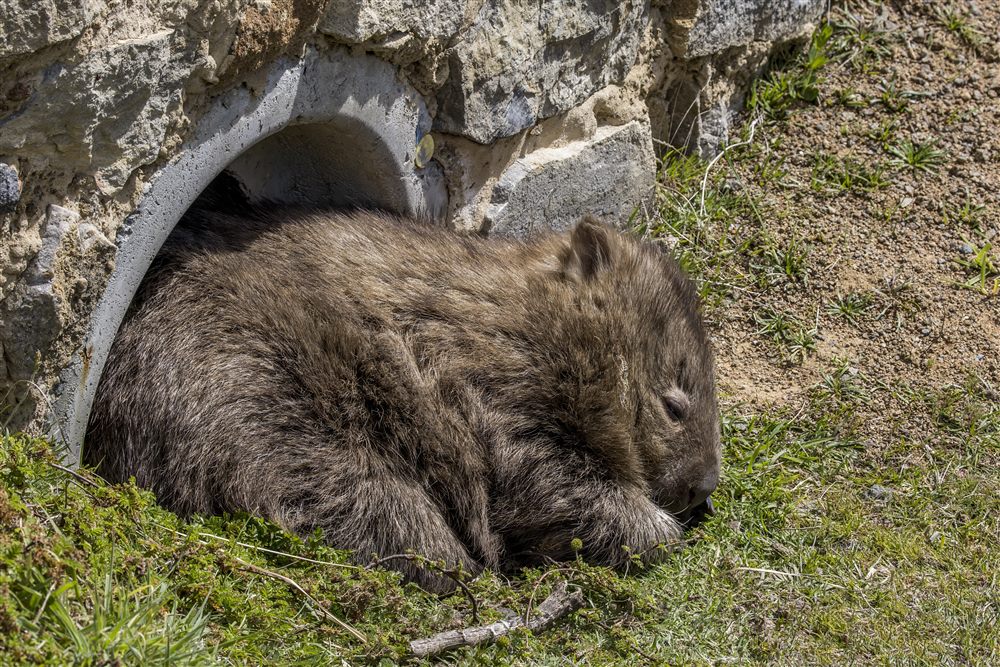
What if it disappeared?
Impact ModerateWithout wombats to dig new ones, the burrow network stops expanding within the first year. Existing burrows don't vanish overnight: in the short term, the species sheltering in them would likely keep benefiting, with no immediately visible change on the landscape.
HypothesisOver ten years, the upkeep that keeps a burrow open and usable would go missing: part of the network would start collapsing or clogging up. That is exactly the kind of burrow that shelters the most species after a fire — sites studied after Australia's 2019-2020 gigafires held more native species around burrows than comparable sites without one.
ExtrapolatedDetail
Extrapolation à partir de Linley, Geary, Jolly et al. (2024), qui mesurent la fonction de refuge des terriers de wombat après les mégafeux australiens de 2019-2020, sans documenter la vitesse à laquelle un terrier laissé à l'abandon perd cette fonction.
Linley et al. (2024), based on 28 burrows and 28 paired control sites monitored by camera traps over 16,645 trap-days after the 2019-2020 gigafires, measures the refuge function of burrows as they exist today — 56 species recorded in total, more around burrows than at control sites. It does not measure how quickly an unmaintained burrow loses that function; that step, plausible but unquantified, is what makes this point an extrapolation rather than a direct result.
What's missing to confirm it: No data on how quickly an abandoned wombat burrow collapses or loses its refuge function was found in the sources gathered here.
A century without wombats, and an entire refuge network would be missing right when Australia faces its most devastating fires. The small vertebrates that, as during the 2019-2020 gigafires, rely on burrows to survive a fire's passage would then have nowhere left to shelter at that scale.
HypothesisOver a thousand years, other small burrowing animals would likely fill part of the gap left by the wombat — but without ever recreating networks as vast, deep, and durable. After every future gigafire, Australian wildlife would face the flames with a permanently thinner safety net.
HypothesisDocumentation
-
IUCN Red List — Vombatus ursinus, statut de conservation
Accessed August 14, 2026
-
Linley et al. (2024) — Wombat burrows are hotspots for small vertebrates in a landscape subject to gigafire, Journal of Mammalogy
Accessed August 14, 2026
-
Knoblauch et al. (2023) — Abundance and population growth estimates for bare-nosed wombats, Ecology and Evolution
Accessed August 14, 2026
Last verified: August 16, 2026