Species → Common Earthworm
Common Earthworm
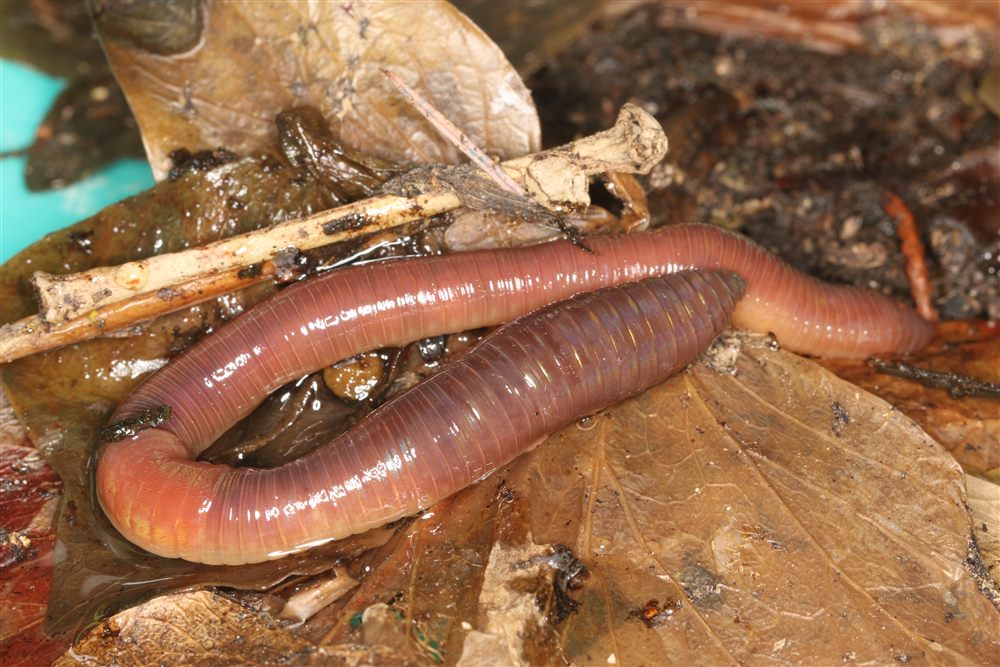
Lumbricus terrestris
What if it disappeared?
Impact ModerateWithout earthworms structuring the soil through their burrows, soil would quickly lose the better drainage, better aeration, and faster organic-matter decomposition this role provides — documented since Darwin's original work, confirmed since by hundreds of field studies.
DocumentedDetail
Darwin, C. (1881). The Formation of Vegetable Mould, through the Action of Worms, with Observations on their Habits. John Murray.
Darwin was the first to document how earthworms turn over and enrich topsoil. The 2019 global compilation confirms and quantifies this role at scale. These benefits depend on continuous burrowing activity; without it, they are lost quickly, within the first growing season.
After ten years without earthworms, organic matter that piles up unburied would form an ever-thicker surface layer instead of mixing into the soil, and the soil would keep losing drainage and aeration rather than settling at a new, stable level.
ExtrapolatedDetail
Extrapolation à partir de Darwin (1881) et des études de terrain confirmant le rôle structurant du ver de terre du vivant de l'espèce — pas d'une mesure directe de dix années sans lui.
The earthworm's role in mixing and decomposing organic matter is documented since Darwin and confirmed by hundreds of field studies, but those studies cover the living, active species, not how a soil evolves after a full decade without it. The reasoning assumes the degradation seen within one season would continue and worsen rather than level off.
What's missing to confirm it: No study tracks a real soil for ten consecutive years without earthworms to confirm whether the degradation keeps worsening or levels off.
A century of intensive tillage and pesticide use has driven down earthworm populations in many farmed soils; those soils now show lower fertility and water-holding capacity than before that decline — though the share attributable to the earthworm's disappearance alone, rather than the practices that come with it, remains hard to isolate.
ExtrapolatedDetail
Phillips, H.R.P., Guerra, C.A., Bartz, M.L.C. et al. (2019). Global distribution of earthworm diversity. Science, 366(6464), 480–485 — extrapolation à partir des patrons mondiaux qu'ils documentent, pas d'une mesure isolée de l'effet de la seule disparition du ver de terre.
This compilation of data from 6,928 sites in 57 countries establishes the global patterns of earthworm abundance and diversity. It does not directly measure the fertility loss caused by their disappearance, but it is consistent with a century of population decline in intensively farmed soils coinciding with lastingly reduced fertility and water retention.
What's missing to confirm it: How much of the agricultural soil fertility loss is directly attributable to declining earthworm populations, rather than to the practices (deep tillage, pesticides) that cause both at once, isn't isolated by the available studies.
Over a thousand years without earthworms, soil would likely lose the mechanism that continuously renews its surface structure: organic matter would pile up in a thick, poorly decomposed layer instead of being mixed into the soil, a state that the species' return probably wouldn't reverse quickly.
HypothesisDocumentation
-
The Effect of Earthworm (Lumbricus terrestris) Population Density and Soil Water Content Interactions on N2O Emissions — Applied and Environmental Soil Science
Accessed August 10, 2026
-
Phillips et al. (2019) — Global distribution of earthworm diversity, Science
Accessed August 7, 2026
Last verified: August 16, 2026