Species → Common Pagoda
Common Pagoda
Mimetes cucullatus
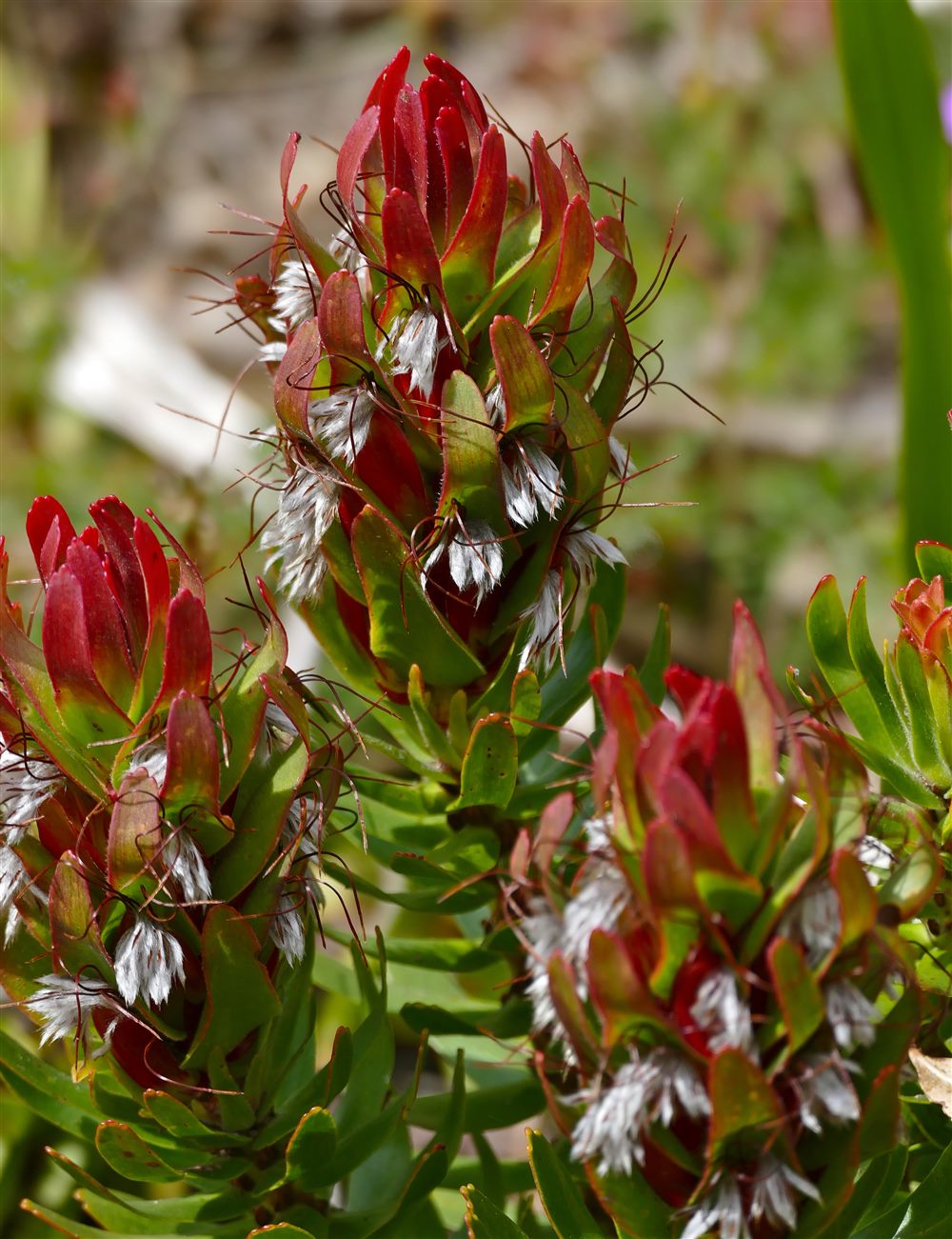
What if it disappeared?
Impact LowThe nectar-feeding birds that visit the common pagoda — sunbirds and Cape sugarbirds — would lose one of their many nectar sources amid the fynbos's rich floral diversity; they would likely turn to other proteas flowering at the same time, with no immediately visible effect on their populations.
HypothesisOver a decade, the fynbos's other proteas — not all as fully dependent on birds for reproduction as the common pagoda — would keep carrying most of the bird-pollination network; the pagoda's disappearance would mainly show up as a localized gap in the patches where it once dominated, not as a wider collapse of that network.
HypothesisOver a century, that gap would likely persist in those patches: its 12 cousin pagoda species, less fire-resistant, struggle more to re-establish after each fire, whereas the common pagoda — the only one in the genus able to resprout from its rootstock instead of depending on heat-triggered seed release — used to fill that role by holding on between fires.
HypothesisOver a thousand years, these patches could lose the genus Mimetes almost for good: without the most fire-resistant species to hold on between fires, and given the fynbos species' limited dispersal ability, recolonization from neighboring populations would remain slow and uncertain.
HypothesisDocumentation
-
IUCN Red List — Mimetes cucullatus, statut de conservation
Accessed August 14, 2026
-
Botha, Pauw & Hui (2015) — How do fynbos plant-pollinator communities respond to the loss of birds?, South African Journal of Botany
Accessed August 14, 2026
-
Botha (2017) — The world without birds: an experimental test of the ecological significance of pollinating birds for plant communities (thèse, Université de Stellenbosch)
Accessed August 14, 2026
Last verified: August 16, 2026