Species → Mexican Free-tailed Bat
Mexican Free-tailed Bat
Tadarida brasiliensis
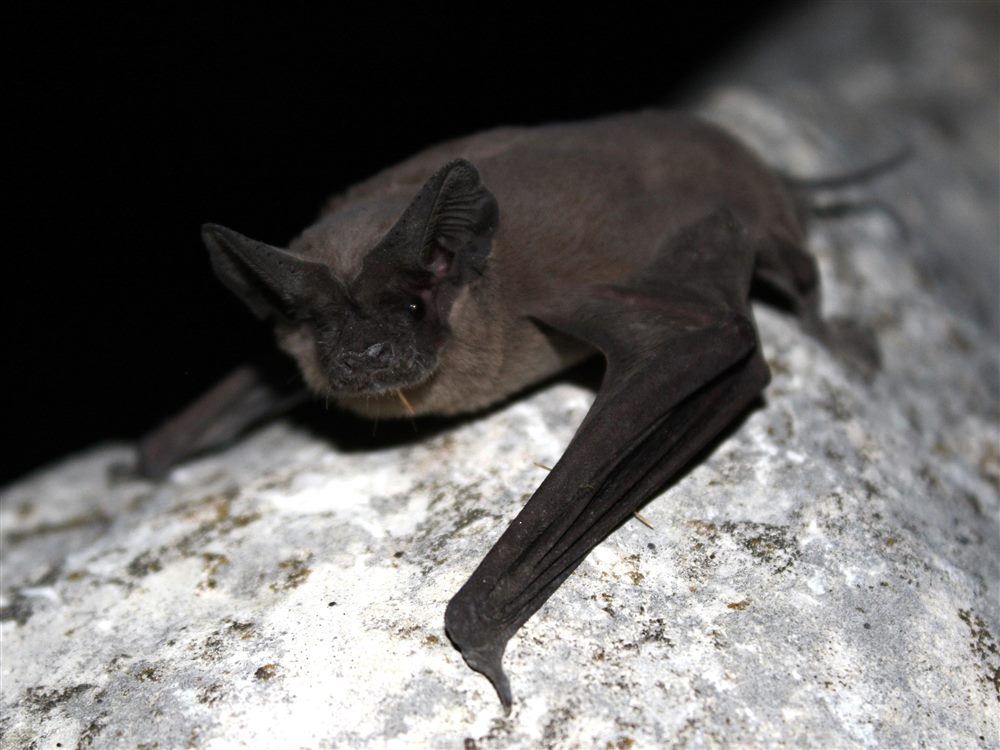
What if it disappeared?
Impact HighWithout the bats, the enormous volume of insects they snatch up each night at Bracken Cave goes uncaught: the 15 million nursing females that gather there each summer alone consume nearly their own body weight in insects nightly, most of them agricultural pests.
DocumentedDetail
Bat Conservation International — Bracken Cave Preserve.
This is the largest known bat colony on Earth, protected since 1991 through the purchase of the cave and surrounding land — a gathering of a density and scale no other insect-eating species in the region reaches at a single site, which makes this nightly predation hard to make up for from the very first season without it.
Year after year, this missing predation would amount, at the rate quantified by a study across eight south-central Texas counties, to as much as $741,000 a year in additional cotton crop damage — several million dollars accumulated over a decade, assuming pest pressure stays comparable from year to year.
ExtrapolatedDetail
Extrapolation à partir de Cleveland, C.J. et al. (2006). Economic value of the pest control service provided by Brazilian free-tailed bats in south-central Texas. Frontiers in Ecology and the Environment, 4(5), 238–243 — l'étude chiffre la valeur annuelle du service rendu par la colonie sur une seule saison, sans mesurer l'effet cumulé d'une absence prolongée.
The authors combine bat diet, the biology of the cotton bollworm (Helicoverpa zea), and regional farming practices to quantify an annual service worth $741,000 — up to $1.7 million in some years — against a cotton harvest worth $4.6 to $6.4 million. Extending that figure over ten years assumes pest pressure and planted acreage stay comparable season to season, which the study does not measure directly.
What's missing to confirm it: No multi-year follow-up confirms whether crop damage would keep accumulating at this rate over a decade, or whether pest populations and farming practices would adjust along the way.
Over a century without a colony of this scale, south-central Texas agriculture would likely have leaned far more heavily on chemical pesticides to make up for the missing nightly predation: other insect-eaters, birds or other bat species, would probably fill only a fraction of it, since none gathers into a single colony of millions at one site.
HypothesisOver a thousand years, even if other colonies eventually formed elsewhere, the precise gathering tradition that concentrates millions of individuals at the same site year after year would likely take generations to rebuild — and caves like Bracken, deprived all that time of the steady guano input that feeds a whole community of cave-dwelling invertebrates there, would likely stay depleted rather than return to their original state.
HypothesisDocumentation
-
IUCN Red List — Tadarida brasiliensis, statut de conservation
Accessed August 14, 2026
-
Bat Conservation International — Visit Bracken Cave Preserve
Accessed August 14, 2026
-
Cleveland et al. (2006) — Economic value of the pest control service provided by Brazilian free-tailed bats in south-central Texas, Frontiers in Ecology and the Environment
Accessed August 14, 2026
Last verified: August 16, 2026