Species → European Pine Marten
European Pine Marten
Martes martes
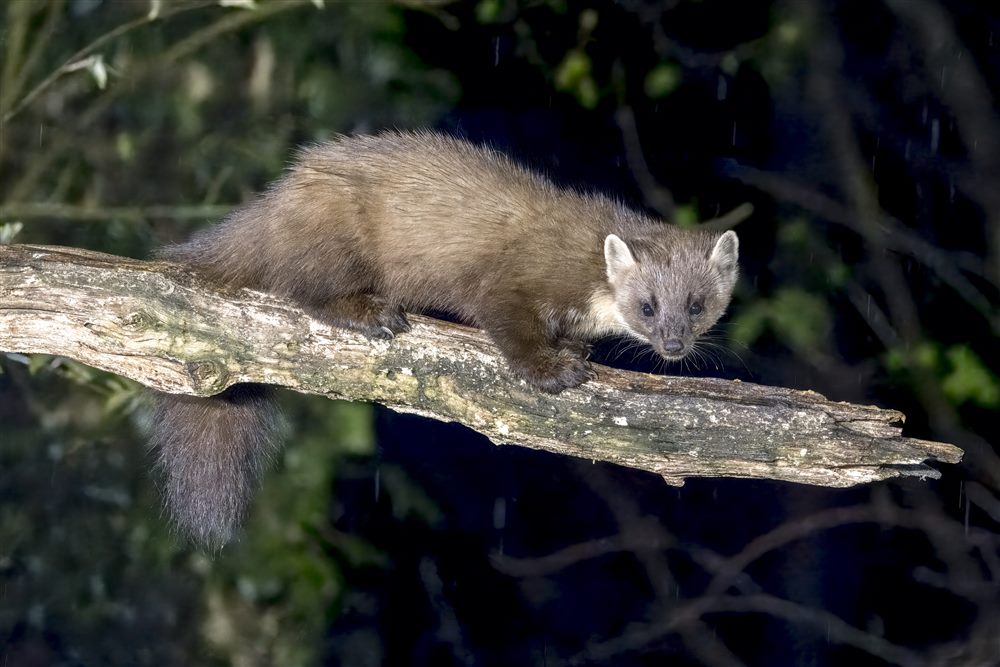
What if it disappeared?
Impact HighWithout the marten to hold it in check, the introduced grey squirrel keeps dominating mixed forests unchecked and displacing the native red squirrel — the exact reverse of what a four-year study in the Irish Midlands documented once the marten recovered locally: a collapse of the grey squirrel and a rapid return of the red squirrel to those same woods.
DocumentedDetail
Sheehy, E. et Lawton, C. (2014). Population crash in an invasive species following the recovery of a native predator: the case of the American grey squirrel and the European pine marten in Ireland. Biodiversity and Conservation, 23(3), 753–774.
A four-year study in the Irish Midlands: where the pine marten recovered, the introduced grey squirrel collapsed locally, and the red squirrel, absent from some sites for more than thirty years, recolonized them. By direct contrast, this means that where the marten stays absent, nothing checks the grey squirrel's dominance over the red squirrel.
The pattern holds at a larger scale and over time: without the marten, the grey squirrel would remain the dominant species and the red squirrel would stay marginal or absent across the whole of Britain and Ireland, not just in a few isolated woods.
DocumentedDetail
Sheehy, E., Sutton, A., Lawton, C. et al. (2018). The enemy of my enemy is my friend: native pine marten recovery reverses the decline of the red squirrel by suppressing grey squirrel populations. Proceedings of the Royal Society B, 285(1874), 20172603.
By broadening the analysis to the British and Irish scale, the study confirms the relationship between marten presence, grey squirrel decline and red squirrel resurgence — ruling out a peculiarity limited to a few sites. By contrast, the marten's absence across this same territory matches the situation that prevailed for decades before any recovery began.
Without the marten to reduce contact between the two squirrel species, squirrelpox — fatal to the red squirrel, harmless to the grey — would likely keep spreading, adding a further pressure on top of direct competitive exclusion and making the red squirrel's decline harder to reverse.
ExtrapolatedDetail
Extrapolation à partir de Slade, A., White, A., Lurz, P.W.W., Shuttleworth, C., Tosh, D. et Twining, J.P. (2023). Indirect effects of pine marten recovery result in benefits to native prey through suppression of an invasive species and a shared pathogen. Ecological Modelling, 476, 110219, qui modélise l'effet du rétablissement de la martre sans mesurer directement le scénario inverse de son absence prolongée.
A modeling study applied to north Wales, combining direct suppression of the grey squirrel by the marten with a second, indirect effect: fewer grey squirrels in contact with red squirrels means less transmission of squirrelpox virus (SQPV). Without the marten, both mechanisms reverse: more contact, more transmission — but this remains a model result, not a direct field measurement.
What's missing to confirm it: Empirical field confirmation, rather than modeling, of the real magnitude of this combined effect (competition and disease) under prolonged marten absence remains to be established.
Over a thousand years, the grey squirrel would likely remain the dominant species of Britain and Ireland's mixed forests: even if the marten eventually returned, a red squirrel gone from nearly all of its former range for so long could no longer recolonize on its own and would need to be reintroduced — a landscape locked into that state, rather than the gradual comeback now underway thanks to the marten's recovery.
HypothesisDocumentation
-
IUCN Red List — Martes martes, statut et données de population régionales
Accessed August 7, 2026
-
Sheehy & Lawton (2014) — Population crash in an invasive species following the recovery of a native predator, Biodiversity and Conservation
Accessed August 7, 2026
-
Sheehy, Sutton, Lawton et al. (2018) — The enemy of my enemy is my friend, Proceedings of the Royal Society B
Accessed August 7, 2026
-
Twining, Montgomery & Tosh (2021) — Declining invasive grey squirrel populations may persist in refugia, Journal of Applied Ecology
Accessed August 7, 2026
-
Slade, White, Lurz, Shuttleworth, Tosh & Twining (2023) — Indirect effects of pine marten recovery, Ecological Modelling
Accessed August 7, 2026
Last verified: August 16, 2026