Species → Antarctic krill
Antarctic krill
Euphausia superba
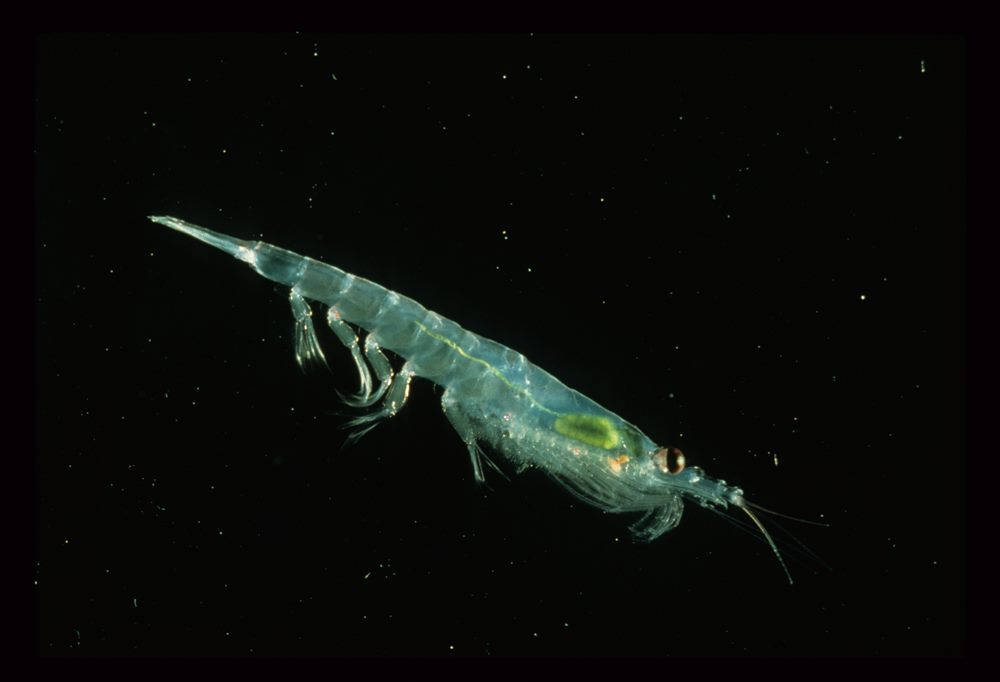
What if it disappeared?
Impact ModerateKrill is the near-exclusive prey of several major Southern Ocean predators — baleen whales in summer, crabeater seals, penguins — with no equivalent backup food source available on short notice. Its disappearance would strip these species of most of their food within a single season, long before any effect showed up in their populations.
HypothesisA model of the Antarctic ecosystem showed that a mere 12% change in krill biomass was enough to drive penguin populations up 17% and seal populations up 12% — a response far out of proportion to the change in their food supply. A total disappearance of krill would, by the same logic run in reverse, trigger a far sharper collapse in those same populations.
ExtrapolatedDetail
Extrapolation à partir de Surma, S., Pakhomov, E.A. et Pitcher, T.J. (2014). Effects of Whaling on the Structure of the Southern Ocean Food Web: Insights on the Krill Surplus from Ecosystem Modelling. PLoS ONE, 9(12), e114978 — relation dose-effet modélisée entre biomasse de krill et populations de manchots/phoques, inversée (perte totale plutôt que hausse de 12 %) et extrapolée bien au-delà de ce que le modèle a testé.
The Surma et al. (2014) model simulates the removal of whales by 20th-century hunting and its cascading effects on the rest of the ecosystem, krill included. The krill increase it predicts (+12%) translated into even sharper increases among the penguins and seals that feed on it — a sign that these predators respond in an amplified way to changes in their main food source, in either direction.
What's missing to confirm it: No study directly models the effect of a total disappearance — rather than a 12% increase — of krill biomass on penguin and seal populations.
Krill has genuinely retreated about 440 kilometers southward since the 1920s as waters have warmed — a real, already-measured contraction, not just a projection. Penguins and other predators tied to their historic breeding colonies, unable to follow that shift as fast as their prey, likely have to travel increasingly far to find krill, or decline locally in the northernmost colonies.
ExtrapolatedDetail
Extrapolation à partir d'Atkinson, A., Hill, S.L., Pakhomov, E.A. et al. (2019). Krill (Euphausia superba) distribution contracts southward during rapid regional warming. Nature Climate Change, 9, 142–147 — qui mesure le déplacement du centre de répartition du krill sans documenter directement l'effet de ce déplacement sur les colonies de prédateurs fidèles à un site.
The 440 km southward shift since the 1920s is a measured fact, not an extrapolation. What remains inferential is the link to predator colonies: several penguin and seabird species return year after year to the same breeding site rather than relocating it with prey, which would limit their ability to track the retreating krill at the same pace.
What's missing to confirm it: No data on the state of penguin or other predator colonies at the historic northern edge of krill's range was found in the sources gathered here.
Over a thousand years, a Southern Ocean without krill would likely never regain the same structure: no other zooplankton species matches its size and density as an efficient food source for large filter feeders. Even if the return of whales someday revived the iron recycling that supports plankton production, the base of the food web would probably remain thinner and more fragmented than before krill's disappearance.
HypothesisDocumentation
-
IUCN Red List / CCAMLR — Euphausia superba, statut et estimation de biomasse
Accessed August 7, 2026
-
Surma, Pakhomov & Pitcher (2014) — Effects of Whaling on the Structure of the Southern Ocean Food Web, PLoS ONE
Accessed August 7, 2026
-
Atkinson, Hill, Pakhomov et al. (2019) — Krill distribution contracts southward during rapid regional warming, Nature Climate Change
Accessed August 7, 2026
Last verified: August 16, 2026