Species → Human Species
Human Species
Homo sapiens
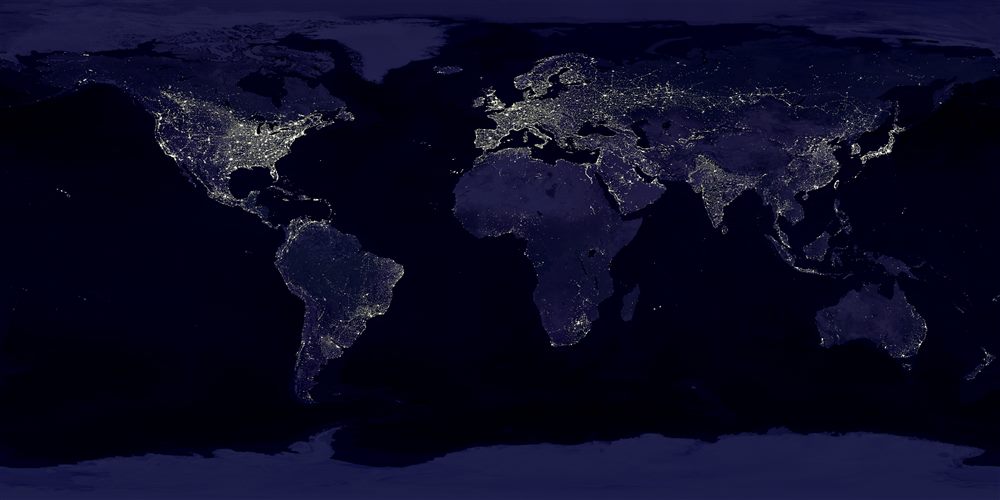
What if it disappeared?
Impact MajorA brief, worldwide slowdown in human activity — the spring 2020 lockdowns — was enough to cut global CO2 emissions by 17% at the peak of the drop, and to directly measure behavioral changes in dozens of wild species, from elusive wildlife reappearing in cities to different vocalizations in urban birds.
DocumentedDetail
Le Quéré, C., Jackson, R.B., Jones, M.W. et al. (2020). Temporary reduction in daily global CO2 emissions during the COVID-19 forced confinement. Nature Climate Change, 10, 647–653.
The term "anthropause," coined by a team of researchers in 2020 (Rutz et al., Nature Ecology & Evolution) to describe precisely this measurable slowdown in human activity, made the journal's September 2020 cover. The measured emissions drop is the largest ever recorded in peacetime — and it fully rebounded as activity resumed in late April 2020, direct proof that the effect tracks ongoing human activity rather than a structural shift.
Deprived of maintenance, human infrastructure would start falling apart almost immediately: the power grid would go dark within days, basement and subway pumps would stop running and flooding would follow, then freeze-thaw cycles would crack pavement and the first trees would break through abandoned parking lots within a decade.
ExtrapolatedDetail
Extrapolation à partir des taux connus de corrosion, de dégradation des matériaux et de cycles gel-dégel documentés en ingénierie civile — aucune expérience de retrait humain à l'échelle d'une ville entière n'a évidemment été menée.
This scenario, popularized by Alan Weisman's book The World Without Us (2007) and the documentary series Life After People, draws on real material-degradation data (steel rust, wood rot, asphalt freeze-thaw) rather than direct observation of an entire abandoned city. The closest real partial case is Pripyat, the city evacuated in 1986 near Chernobyl, whose decay over nearly four decades confirms the scenario's general direction — without covering every climate or every scale of city.
What's missing to confirm it: No entire city has been observed over decades following a total, simultaneous human abandonment across varied climates; partial cases (Pripyat, deserted neighborhoods of Detroit) illustrate the mechanism without confirming it at global scale.
The closest thing to a real-world experiment at this scale already exists, even though it hasn't run a full century yet: in the Chernobyl Exclusion Zone, abandoned by 116,000 people in 1986, large mammals (elk, roe deer, red deer, wild boar) already reach — after fewer than forty years of human absence — densities comparable to nearby uncontaminated nature reserves, and wolves are more than seven times as abundant. If this trajectory holds, wildlife there should be fully re-established well before the century mark.
ExtrapolatedDetail
Extrapolation au-delà de la période mesurée à partir de Deryabina, T.G., Kuchmel, S.V., Nagorskaya, L.L. et al. (2015). Long-term census data reveal abundant wildlife populations at Chernobyl. Current Biology, 25(19), R824–R826 — l'étude mesure directement près de quarante ans d'absence humaine, pas un siècle complet.
The study draws on aerial censuses and track surveys spanning decades, compared against four uncontaminated nature reserves in the region. The finding isn't that radiation is harmless — it has measurable effects on some organisms — but that the removal of hunting, farming, forestry, and roads outweighs residual contamination as a pressure on wildlife. Nothing guarantees this trajectory holds unchanged all the way to a full century, though: it's the best real-world data available, not a measurement taken at the century mark itself.
What's missing to confirm it: No site has yet reached a full century of total human withdrawal with continuous wildlife monitoring; Chernobyl, abandoned for fewer than forty years as of 2026, is the closest real case but remains under half of that horizon.
At a thousand years, nearly every city has long since given way to forest — that shift is already well underway after a century — but some traces persist far beyond that: the magnetic signature of steel rebar in the soil, plastics, and nuclear waste that stays hazardous for tens of thousands of years for some of it. Atmospheric carbon also takes centuries to millennia to come back down toward pre-industrial levels, long after the buildings themselves are gone.
ExtrapolatedDetail
Synthèses d'ingénierie et de vulgarisation scientifique (Weisman 2007 ; BBC Science Focus ; Popular Science) croisant des données de corrosion, de décomposition des polymères et de radioactivité résiduelle — pas une étude unique et continue sur un siècle, qui par nature n'existe pas encore.
The return of atmospheric carbon to pre-industrial levels would itself take centuries to millennia according to existing climate models, long after the buildings themselves are gone — two very different clocks running in parallel, one for the built environment and one for the climate.
What's missing to confirm it: No complete century-long trajectory has ever been observed anywhere: every source combines partial estimates (corrosion, polymers, climate) that have never been tracked together at a single site abandoned for that long.
Documentation
-
Le Quéré et al. (2020) — Temporary reduction in daily global CO2 emissions during the COVID-19 forced confinement, Nature Climate Change
Accessed August 10, 2026
-
Rutz et al. (2020) — COVID-19 lockdown allows researchers to quantify the effects of human activity on wildlife, Nature Ecology & Evolution
Accessed August 10, 2026
-
Deryabina et al. (2015) — Long-term census data reveal abundant wildlife populations at Chernobyl, Current Biology
Accessed August 10, 2026
-
Worldometer — World Population Clock (données dérivées des estimations ONU)
Accessed August 10, 2026
Last verified: August 16, 2026