Species → Sandfish Sea Cucumber
Sandfish Sea Cucumber
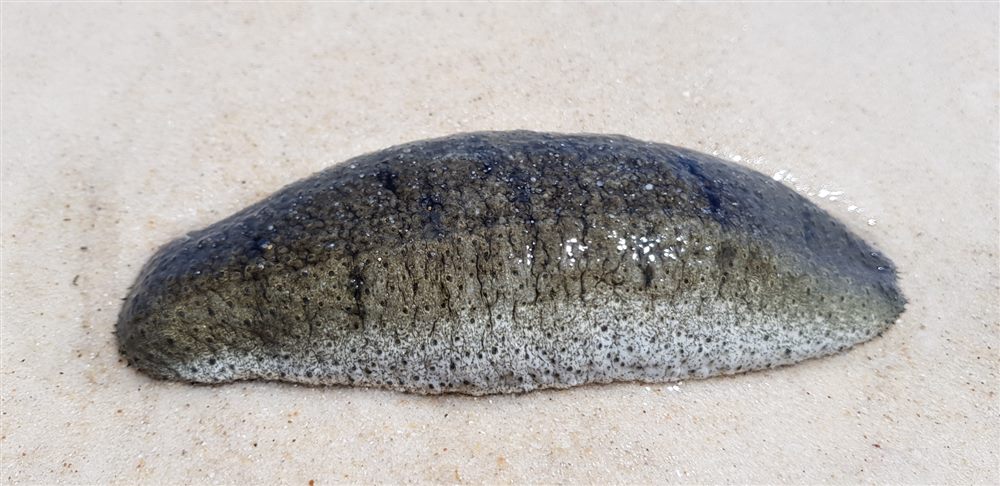
Holothuria scabra
What if it disappeared?
Impact ModerateExperimentally removed from sediment plots for six months, the sandfish leaves the seafloor losing its healthy oxygenation fast: sediment oxygen consumption doubles within the first month without it, and its resistance to a heat spike collapses — oxygen penetration depth falls by 63% during a water-warming episode, a collapse absent where the species remains present.
DocumentedDetail
Lee, S., Ford, A.K., Mangubhai, S., Wild, C. et Ferse, S.C.A. (2018). Effects of sandfish (Holothuria scabra) removal on shallow-water sediments in Fiji. PeerJ, 6, e4773.
By continuously burrowing through and filtering sediment to feed, the sandfish maintains the aerobic conditions the seafloor community depends on. The six-month removal experiment isolates this effect precisely on real plots: without the species, sediment becomes markedly more vulnerable to heat stress — a buffering effect lost within the first months of its absence.
If this oxygen shortfall persisted for years rather than six months, organic matter would build up unturned and the sediment would likely become chronically low in oxygen — a prolonged stress that would threaten seagrass root systems and water quality around the coral reefs the species lives near.
ExtrapolatedDetail
Extrapolation à partir de Lee et al. (2018), qui établissent le mécanisme (perte de bioturbation → chute d'oxygène) sur six mois seulement — aucune étude publiée ne prolonge cette mesure sur plusieurs années.
The mechanism the removal experiment demonstrates — less bioturbation, less oxygen — has no reason to stop after six months: extended over years, it points toward chronically hypoxic sediment, with a cumulative effect from unturned organic matter. This extension remains reasoning, not a measurement.
What's missing to confirm it: No field study has tracked a sandfish-free plot over multiple years to confirm that the hypoxia seen at six months becomes chronic, nor to measure a direct effect on nearby seagrass beds or reefs.
Over a century without sandfish anywhere in its range, large stretches of tropical seagrass beds and sandy seafloor would likely live with sediment that is durably less oxygenated and more vulnerable to repeated marine heatwaves — but no real-world place has yet let this scenario be checked over that long a span.
HypothesisOver a thousand years, this repeated oxygen shortfall could favor sediment organisms tolerant of low oxygen over those that depend on it, durably reshaping the makeup of the seafloor community — a state that likely would not return to identical even if the species came back.
HypothesisDocumentation
-
IUCN Red List — Holothuria scabra, évaluation 2013 (Hamel et al.)
Accessed August 14, 2026
-
Lee, Ford, Mangubhai, Wild & Ferse (2018) — Effects of sandfish (Holothuria scabra) removal on shallow-water sediments in Fiji, PeerJ
Accessed August 14, 2026
Last verified: August 16, 2026