Species → Ganges River Dolphin
Ganges River Dolphin
Platanista gangetica
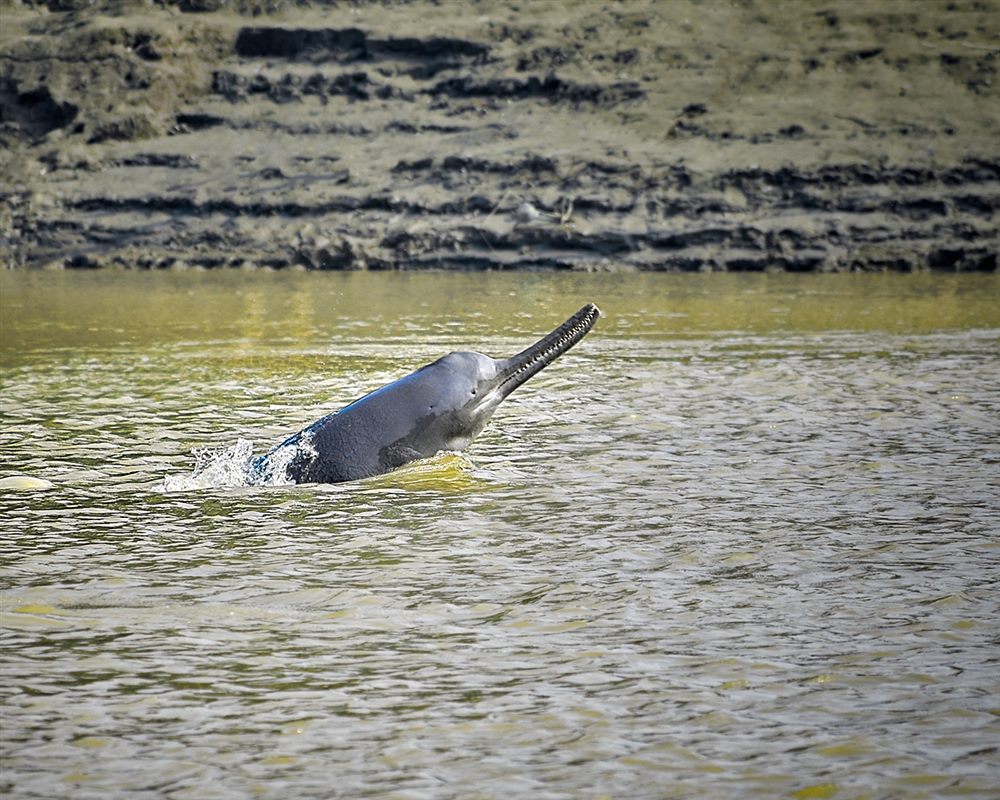
What if it disappeared?
Impact ModerateWithout the continuous clicks that let it track fish and shrimp in water too murky for sight, those prey would almost immediately lose one of the few predators able to hunt them effectively in that opaque water.
ExtrapolatedDetail
Extrapolation à partir de Jensen, F.H. et al. (2013), Clicking in Shallow Rivers: Short-Range Echolocation of Irrawaddy and Ganges River Dolphins, PLoS ONE — l'étude documente le mode de chasse par écholocation continue, pas la réponse des populations de proies à sa disparition.
The clicks Jensen and colleagues measured (mean centroid frequency of 61.4 kHz, emitted at a median interval of 27.8 milliseconds) show a continuous hunting pattern with no known equivalent among the basin's other predators, suited to detecting prey at very short range in silty water. That this hunting method's disappearance would almost immediately relieve pressure on the fish and shrimp it targets is a direct extrapolation of this finding, not a field measurement.
What's missing to confirm it: No study directly measures how fish and shrimp populations would respond to the dolphin's disappearance — the extrapolation rests on the documented hunting method, not a population survey.
Over a decade, that reduced pressure would likely reshape the balance between the fish and shrimp the dolphin targeted and the rest: the former would gain ground, since no other river predator hunts the same way — continuously, by echolocation, in such murky water.
HypothesisOver a century, this imbalance would probably settle into a new state: a river permanently left without any hunter using continuous echolocation to track prey through its murkiest stretches — a role no other species in the basin fills the same way.
HypothesisOver a thousand years, nothing would truly replace this blind, sound-guided hunter: no other predator in the basin has adapted, across more than 30 million years of evolution, to hunt continuously by echolocation in such opaque water — its disappearance would leave a mode of predation no other species would ever recreate, even after a millennium.
HypothesisDocumentation
-
IUCN Red List — Platanista gangetica, statut de conservation
Accessed August 14, 2026
-
Jensen et al. (2013) — Clicking in Shallow Rivers: Short-Range Echolocation of Irrawaddy and Ganges River Dolphins, PLoS ONE
Accessed August 14, 2026
-
Sinha & Kannan (2014) — Ganges River Dolphin: An Overview of Biology, Ecology, and Conservation Status in India, Ambio
Accessed August 14, 2026
Last verified: August 16, 2026