Species → Staghorn Coral
Staghorn Coral
Acropora cervicornis
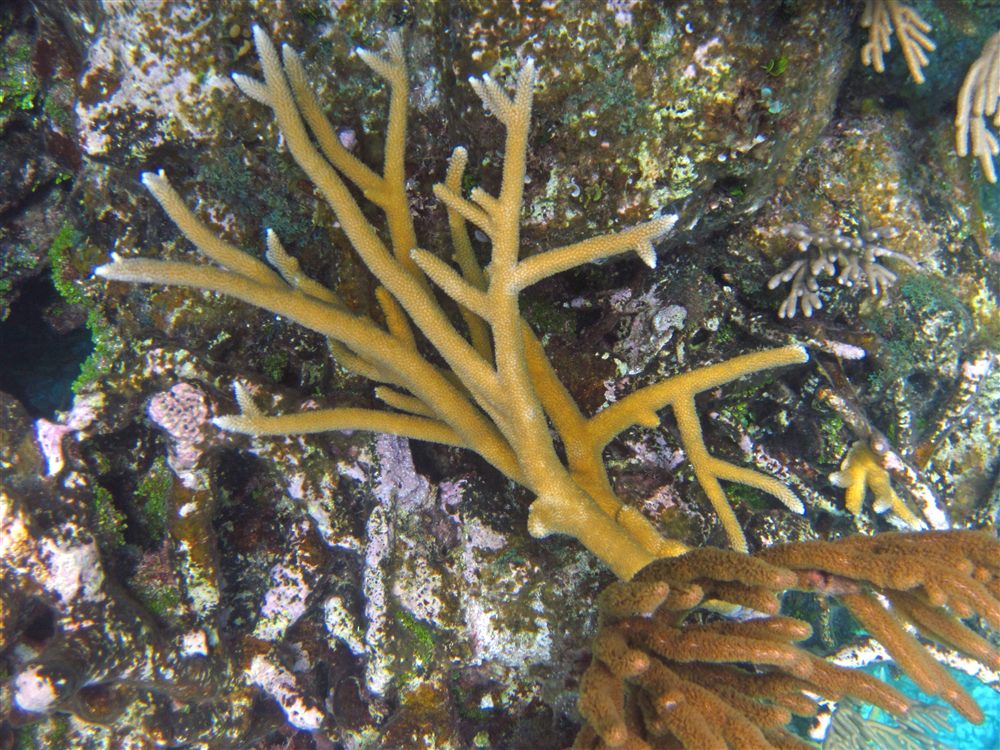
What if it disappeared?
Impact MajorOne year after mortality as massive as that caused by the 2023 marine heatwave — 98 to 100% in the Florida Keys and Dry Tortugas — the few surviving staghorn corals are no longer enough to keep building the reef's structure: researchers call this threshold 'functional extinction,' a stage that often precedes complete extinction.
DocumentedDetail
Étude à 47 auteurs et 22 institutions (2025). Heat-driven functional extinction of Caribbean Acropora corals from Florida's Coral Reef. Science, 23 octobre 2025.
Mortality was not uniform: off the southeast Florida coast, more exposed to water mixing, it reached 'only' about 38% — evidence that local geography can still make a difference even under extreme thermal stress. But in the Keys and the Dry Tortugas, the few remaining colonies are too scattered to sustain the growth and reproduction needed to maintain the reef's structure.
Ten years after staghorn coral is lost from a reef, the diversity of fish living there also tends to decline — even if total coral cover stays good: a Great Barrier Reef study shows it's the diversity of coral species present, not just the amount of living coral, that most determines fish diversity.
ExtrapolatedDetail
Extrapolation à partir de González-Barrios, Keith, Graham et al. (2025), Emergent patterns of reef fish diversity correlate with coral assemblage shifts along the Great Barrier Reef, Nature Communications — étude portant sur la Grande Barrière, pas sur les récifs des Caraïbes ni spécifiquement sur le corail corne de cerf.
The study draws on 25 years of data covering six mass bleaching events between 1998 and 2022. Changes in fish diversity track changes in coral composition geographically, not just fluctuations in cover — a mechanism with no particular reason to stop at the Caribbean, but one that has only been measured on the Great Barrier Reef.
What's missing to confirm it: Replicating this coral-fish relationship on a Caribbean reef that has lost staghorn coral would confirm it applies to this species and region.
A century after staghorn coral is lost, the complex, branching structure it once formed would likely still struggle to rebuild: increasingly frequent marine heatwaves would keep fast-growing corals like it from regaining a foothold before the next one hits, leaving the reef durably simpler and less welcoming to the fish that once sheltered there.
HypothesisOver a thousand years without staghorn coral to quickly rebuild its branching structure, the reef itself could gradually flatten, as coral-skeleton buildup no longer keeps pace with erosion — a flatter profile that would durably offer fewer hiding places for fish, even once other, slower-growing corals eventually occupy the space.
HypothesisDocumentation
-
IUCN — Over 40% of coral species face extinction (Liste rouge, novembre 2024)
Accessed August 7, 2026
-
González-Barrios, Keith, Graham et al. (2025) — Emergent patterns of reef fish diversity correlate with coral assemblage shifts, Nature Communications
Accessed August 7, 2026
-
University of Miami Rosenstiel School — Functional extinction of two critically endangered coral species (octobre 2025)
Accessed August 7, 2026
Last verified: August 16, 2026