Species → Northern Red Oak
Northern Red Oak
Quercus rubra
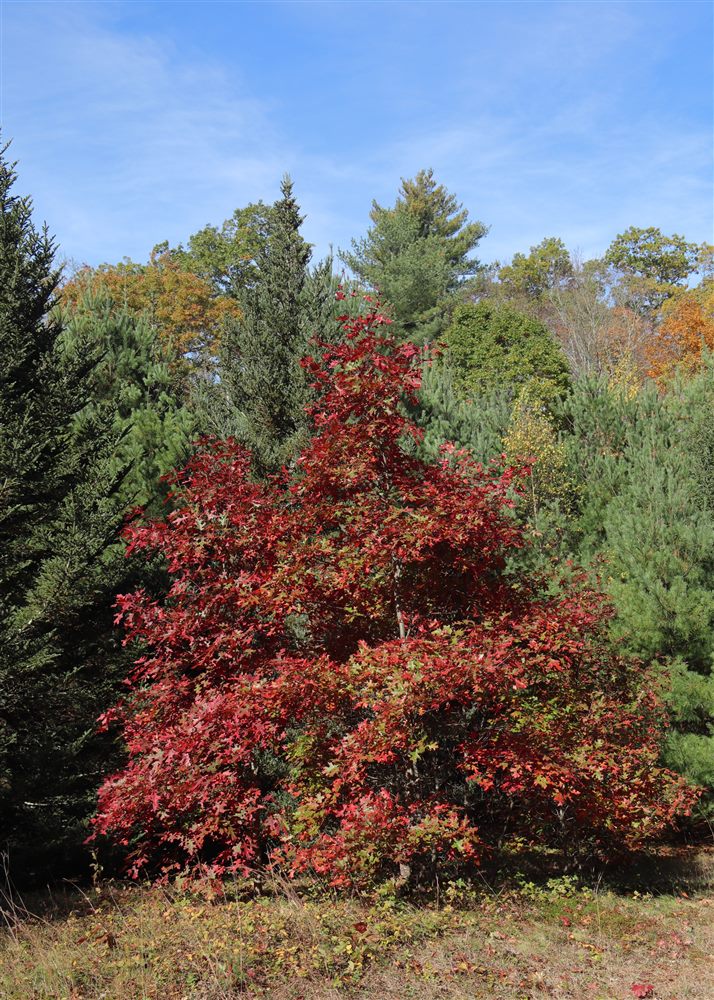
What if it disappeared?
Impact HighWithout red oak, the acorn drop stops cold: according to a thirteen-year study in the deciduous forests of New York State, an acorn shortfall causes the summer population of white-footed mice to collapse — and since these mice are an important predator of gypsy moth caterpillars, their collapse immediately releases the insect from that pressure, opening the way to defoliating outbreaks.
DocumentedDetail
Jones, C.G., Ostfeld, R.S., Richard, M.P., Schauber, E.M. et Wolff, J.O. (1998). Chain reactions linking acorns to gypsy moth outbreaks and Lyme disease risk. Science, 279(5353), 1023–1026.
This study was the first to establish the complete acorn-mouse-tick-gypsy moth chain in the oak forests of the eastern United States, by observing what happens in years when acorns are scarce: the white-footed mouse population collapses, releasing the gypsy moth from its main caterpillar predator. Red oak's complete disappearance reproduces the conditions of a shortfall from the very first year — only permanently.
From a single lean year, the forest would shift to permanent scarcity: without a heavy mast year ever returning to rebuild the mouse population and its predation pressure on the caterpillars, gypsy moth defoliation outbreaks would become chronic rather than the isolated episodes seen after just one bad acorn year.
ExtrapolatedDetail
Extrapolation à partir de Jones et al. (1998) et Ostfeld et al. (2006), qui documentent la disette et la glandée comme un cycle alterné : le raisonnement étend le mécanisme d'une seule mauvaise année à une absence permanente, jamais mesurée sur dix années consécutives dans les sources réunies ici.
Both reference studies document a cycle that alternates mast years and lean years — never ten consecutive years without a single acorn, a situation that never occurred naturally in the studied forests since red oak remained present throughout.
What's missing to confirm it: No study has measured the frequency and intensity of gypsy moth outbreaks over ten consecutive years without any mast year at all.
Over a century, other synchronously masting trees present in the same forests — beech, hickory — would likely offer mice a partial food pulse, softening but not erasing the chronic gypsy moth outbreak regime that set in after red oak's disappearance. The well-documented calendar linking mast years, mice, and Lyme disease risk would stay lastingly out of sync, never regaining its original regularity.
ExtrapolatedDetail
Extrapolation à partir du régime de glandée synchronisée documenté chez d'autres essences forestières (dont le hêtre, voir Bogdziewicz et al. 2021) et du mécanisme glands-souris-spongieuse établi par Jones et al. (1998) : le raisonnement combine deux mécanismes documentés séparément, jamais mesurés ensemble sur un siècle d'absence du chêne rouge.
Synchronized mast seeding is not unique to red oak: beech and hickory share the same pulsed reproductive mode. However, no study measures, within the same forest, the exact share these species could take in the mice's food pulse once red oak is gone, nor how long that partial pulse would dampen the chronic outbreak regime.
What's missing to confirm it: No study measures, within the same forest, the relative contribution of beech or hickory to the mice's food pulse once red oak has disappeared.
Over a thousand years, the forest canopy would likely reorganize around species that don't produce mast crops as massive or as tightly synchronized as red oak's, such as maple. The precise calendar that today links mast years, mice, ticks, and gypsy moths would probably never recur in quite the same way, even if red oak eventually recolonized the region.
HypothesisDocumentation
-
IUCN Red List — Quercus rubra, statut de conservation
Accessed August 7, 2026
-
Ostfeld, Canham, Oggenfuss, Winchcombe & Keesing (2006) — Climate, Deer, Rodents, and Acorns as Determinants of Variation in Lyme-Disease Risk, PLoS Biology
Accessed August 7, 2026
-
Jones, Ostfeld, Richard, Schauber & Wolff (1998) — Chain reactions linking acorns to gypsy moth outbreaks and Lyme disease risk, Science
Accessed August 7, 2026
-
Bogdziewicz et al. (2021) — Climate change weakens the tie between weather and mast seeding, Communications Biology
Accessed August 7, 2026
Last verified: August 16, 2026