Species → Southern Cassowary
Southern Cassowary
Casuarius casuarius
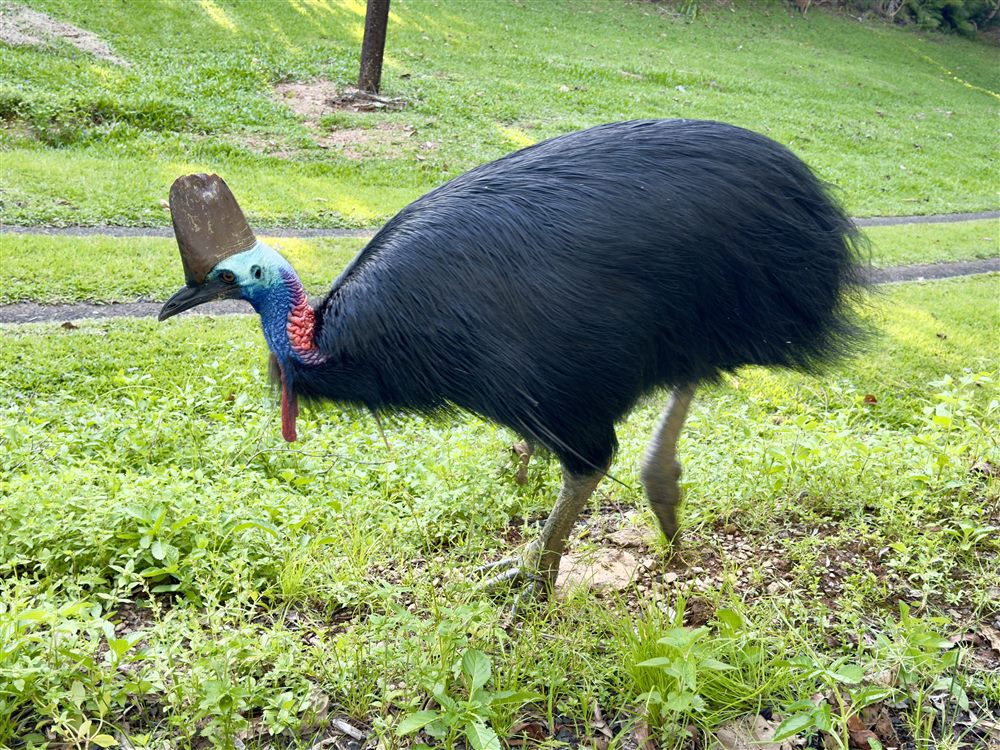
What if it disappeared?
Impact HighWithout the cassowary, the fruit of the more than 70 tree species it alone can swallow simply piles up beneath the parent tree: no other forest animal has a mouth big enough to carry it anywhere else.
ExtrapolatedDetail
Extrapolation directe à partir du rôle de disperseur exclusif documenté par la Wet Tropics Management Authority (gouvernement du Queensland) — aucune étude ne mesure directement l'arrêt de la dispersion après une disparition du casoar.
The Wet Tropics Management Authority documents that the cassowary is the only animal in Australia's tropical rainforest able to swallow whole the fruit of more than 70 tree species, too large for any other local disperser. Its disappearance would therefore mechanically — not gradually — remove the only means of carrying these seeds beyond the parent tree's shade.
What's missing to confirm it: A direct measurement of undispersed fruit accumulation following an actual cassowary disappearance, rather than an inference from its exclusive disperser role documented while it is still present.
Ten years on, the trend already shows where cassowaries are thinning out: in Queensland's forests most fragmented by urbanization, the share of native seeds it still carries is already giving way to exotic fruit — a preview of what a full disappearance would lock in for good.
ExtrapolatedDetail
Extrapolation à partir de Campbell et al. (2023), qui mesurent l'érosion de la fonction de disperseur natif du casoar le long d'un gradient de fragmentation forestière, sans documenter sa disparition complète.
By fitting cassowaries with an ingestible tracking device across four Wet Tropics sites with varying degrees of urbanization, Campbell et al. show that birds in the most intact forests feed almost exclusively on native fruit, while those in the most urbanized areas already pass more exotic seeds — the function degrades before the bird even disappears locally.
What's missing to confirm it: Comparable tracking in a forest where the cassowary has fully disappeared, rather than one where its presence is merely declining, to confirm the trend continues all the way to a full stop.
A century without cassowaries, and the saplings that never managed to establish far from their parent tree would have had time to be wiped out on the spot: seedlings growing right beneath a large tree of the same species are the most exposed to the diseases and insects that build up there, a well-known pattern in forests. These tree species would then occupy an ever-shrinking range, without ever fully disappearing.
HypothesisOver a thousand years, several of these large-fruited trees would likely have disappeared from the most fragmented forests, replaced in the canopy by species spread by wind or small animals: a rainforest still dense, but never again home to the same lineup of trees that the cassowary once sustained.
HypothesisDocumentation
-
IUCN Red List — Casuarius casuarius, statut de conservation
Accessed August 14, 2026
-
Wet Tropics Management Authority — Cassowaries
Accessed August 14, 2026
-
Campbell et al. (2023) — The southern cassowary (Casuarius casuarius johnsonii) remains an important disperser of native plants in fragmented rainforest landscapes, Austral Ecology
Accessed August 14, 2026
-
Mongabay (mai 2026) — Amid efforts to save Australia's southern cassowaries, their numbers remain unknown
Accessed August 14, 2026
Last verified: August 16, 2026