Species → European Bison
European Bison
Bison bonasus
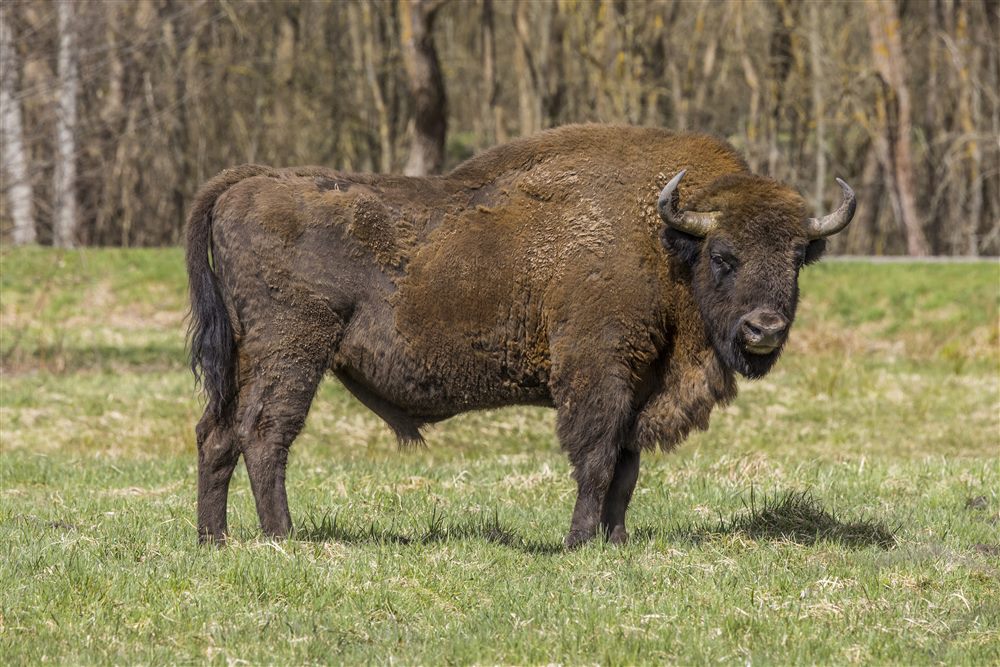
What if it disappeared?
Impact HighWithout bison to carry seeds in their dung, a forest immediately loses a broad-spectrum disperser: one study recorded 10,807 seedlings from 178 different plant species germinating from bison dung alone — a diversity nothing else in the forest reproduces at that scale.
DocumentedDetail
Jaroszewicz, B., Pirożnikow, E. & Sagehorn, R. (2009). Endozoochory by European bison (Bison bonasus) in Białowieża Primeval Forest across a management gradient. Forest Ecology and Management, 258(1), 11-17.
Based on 74 dung samples collected in Białowieża Forest, comparing three management regimes (captive, semi-wild, wild). Curiously, captive bison, partly fed by humans, dispersed an even greater seed diversity than free-ranging bison — a reminder that this service depends on the animal itself, not just its lifestyle. Without any bison at all, none of these 178 taxa would benefit from this dispersal route any longer.
Ten years without bison passing through and grazing, ground beetle (carabid) diversity would likely drift toward the 32 to 35 species recorded on plots bison have never grazed, compared to up to 57 species on plots it still grazes today — a sign that its trampling shapes life in the soil as much as the visible vegetation.
ExtrapolatedDetail
Extrapolation à partir de Schwerk, A., Klich, D., Wójtowicz, E. & Olech, W. (2021), qui compare des parcelles broutées et non broutées par le bison au même moment plutôt que le même site avant et après sa disparition.
Based on three bison populations in Poland (over 21,000 carabids identified in total). The clearest effect isn't on abundance but on the beetles' functional traits (size, diet, flight ability) — a sign that bison filters which types of carabids thrive rather than simply changing how many there are. The study compares different plots at the same point in time, not the same plot before and after bison are removed; the link to the ten-year horizon is therefore reasoning, not a direct measurement.
What's missing to confirm it: Tracking the same plot over time, before and after bison are removed, would confirm the real pace of this decline, rather than comparing different plots at a single point in time.
The last wild bison died in 1927 — nearly a century before today. Since then, the species has rebuilt from a founding stock of just 12 individuals to more than 6,800 wild bison across 47 herds, but only 8 of those herds are large enough to be genetically viable long-term: a century has been enough to bring the bison back onto the landscape, not yet enough to restore its megaherbivore and seed-disperser role continuously across it.
ExtrapolatedDetail
Extrapolation à partir des données de population de l'UICN sur l'extinction du bison sauvage en 1927 et sa reconstitution depuis un stock fondateur de 12 individus, combinée à Jaroszewicz et al. (2009) et Schwerk et al. (2021) sur son rôle écologique actuel.
The average inbreeding coefficient of current populations is around 17%, a level associated elsewhere in the animal kingdom with reduced fertility and lower disease resistance. Only 8 of the 47 current herds exceed the threshold for long-term genetic viability — the bison's ecological function, as measured by the studies above, has therefore likely not yet regained the continuous scale it held before 1927, even where the species has returned in number.
What's missing to confirm it: A direct measurement of ecological function (seed dispersal, effect on carabids) compared across herds with contrasting genetic diversity, at comparable density and habitat, would confirm whether fragmentation actually limits the bison's ecological role.
Over a thousand years, even if bison numbers kept growing, the very narrow genetic diversity inherited from its 12 founders would likely limit its ability to reoccupy the whole of its historic range. The species would probably resume its role as megaherbivore and seed disperser in places, but likely never as continuously as before its near-extinction — a patchwork of bison-shaped forests and grasslands, broken up by areas it never fully reclaimed.
HypothesisDocumentation
-
Jaroszewicz, Pirożnikow & Sagehorn (2009) — Endozoochory by European bison in Białowieża Primeval Forest across a management gradient, Forest Ecology and Management
Accessed August 10, 2026
-
Schwerk et al. (2021) — Impact of European bison grazing on species and functional traits of carabid beetle assemblages in selected habitats in Poland, Biology
Accessed August 10, 2026
-
IUCN Red List — Bison bonasus, statut et estimation de population
Accessed August 10, 2026
Last verified: August 16, 2026