Species → Joshua Tree
Joshua Tree
Yucca brevifolia
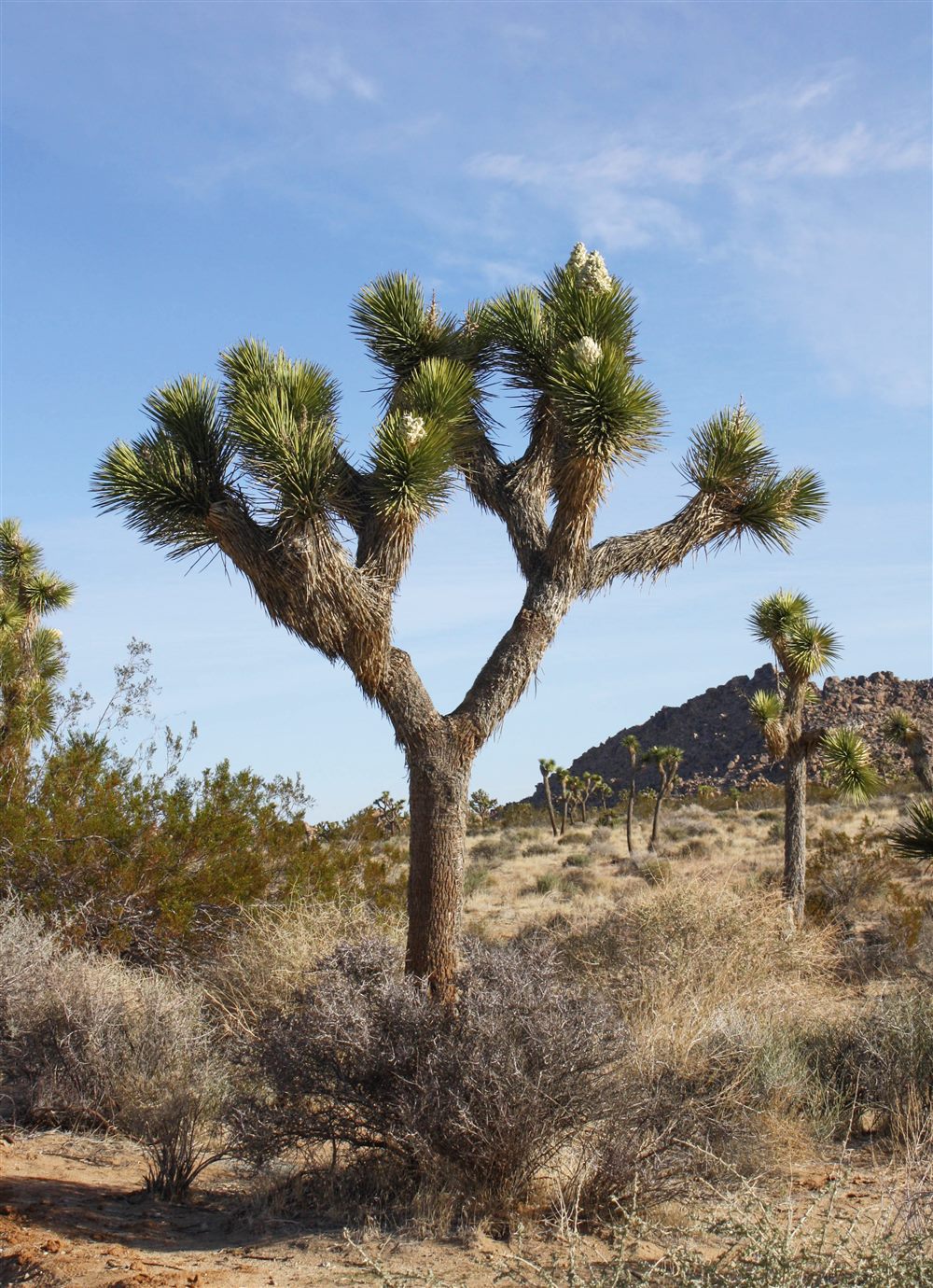
What if it disappeared?
Impact ModerateWithout the Joshua tree, the yucca moth — its only pollinator, whose larvae grow inside its very fruit — instantly loses the one flower where it can lay its eggs and the one fruit its larvae feed on. The mutualism that binds the two species stops cold, not just for the tree.
ExtrapolatedDetail
Extrapolation à partir d'Addicott & Bao (1999), qui documentent le mécanisme du mutualisme (ponte dans la fleur, larves nourries par les graines) sans mesurer ce qui arrive à la teigne une fois la plante hôte disparue.
Addicott & Bao's study describes a reciprocal obligate mutualism: the tree reproduces only through the moth, and the moth can only lay eggs and feed its larvae in the tree's flowers and fruit. The host plant's disappearance therefore also cuts off the insect's only reproductive resource — a direct inference from the documented mechanism, though the study itself doesn't measure this since it studies living populations of both species.
What's missing to confirm it: No study directly measures what happens to the yucca moth after its sole host plant disappears — only the mechanism of mutual dependence is documented.
Deprived of any host for ten years, the yucca moth — an insect specialized on this one tree species — would have vanished from the region in turn: what was a single failed breeding season in year one becomes the complete local extinction of its sole pollinator.
ExtrapolatedDetail
Extrapolation à partir d'Addicott & Bao (1999) et de Harrower & Gilbert (2018), qui montrent que le mutualisme peut s'effondrer localement quand la teigne n'est plus active — ici appliqué au cas plus extrême où la plante hôte elle-même a disparu.
Harrower & Gilbert document, along a climate gradient, sites where the mutualism collapses locally because the moth stops being active while the tree is still present. If the reverse happens — the tree disappears while the moth depends solely on it — the mutualism's collapse should be even faster and more complete, since the moth has no other host to fall back on.
What's missing to confirm it: No data tracks a yucca moth population over ten years following the complete disappearance of its host — the extrapolation combines two studies that each cover a different part of the system.
A century without the Joshua tree would be a century without the tall, tree-like yucca that shapes parts of the Mojave Desert today. The rodents that once dispersed its seeds would likely turn to other food sources, and nothing says another plant would come to occupy exactly the same place in the desert landscape — its distinctive shape and growth habit have no close equivalent among the Mojave's other species.
HypothesisOver a thousand years, the Mojave Desert would likely have settled into a different plant balance — other shrubs or smaller yuccas filling part of the empty space — but probably never quite the same shape, nor the same exclusive relationship with a pollinator that would, by then, no longer exist at all: once the yucca moth is gone for lack of a host, no yucca species could bring it back.
HypothesisDocumentation
-
IUCN Red List — Yucca brevifolia, statut de conservation
Accessed August 14, 2026
-
Addicott & Bao (1999) — Limiting the costs of mutualism: multiple modes of interaction between yuccas and yucca moths, Proceedings of the Royal Society B
Accessed August 14, 2026
-
Harrower & Gilbert (2018) — Context-dependent mutualisms in the Joshua tree-yucca moth system shift along a climate gradient, Ecosphere
Accessed August 14, 2026
-
Cole et al. (2011) — Past and ongoing shifts in Joshua tree distribution support future modeled range contraction, Ecological Applications
Accessed August 14, 2026
Last verified: August 16, 2026